Monday, June 19, 2006

Your kids, martial arts & the internet


By Joel Persinger

The internet is a great tool and one which my family uses all the time. I use it for work, my wife uses it for research and fun and my son uses it to help with his school work. Let's face it; it’s a terrific tool most of the time. However, my wife and I agreed years ago that we would have every content filter known to man on our systems to keep the garbage out and we would never put our children's pictures on the internet. We've just heard too many horror stories about kids who have their faces and locations plastered all over the net for every nutcase in the world to see.

So what's the point Joel? After all this is a martial arts blog. What are you talking about the internet for?

The point is that you don’t “do” martial arts, you live them. The study of martial arts starts with humility. Humility teaches us that we cannot win every fight and that martial studies are not about fighting but learning not to fight. Fighting is done only as a last possible resort. Therefore, we take steps to avoid conflict where possible. Certainly there are conflicts and dangers we can reasonable avoid when it comes to our children.

Take my son for example. He is a teenager now and a 1st degree black belt in Tang Soo Do. He's also 6'1" and 205 lbs. He's a great kid with a good solid head on his shoulders and a good heart. Consequently, I don't worry about him quite like I used to.

Earlier today he helped me demonstrate some martial techniques while one of his friends took some pictures. I had received a number of emails with questions regarding an ongoing class that David Collins and I are teaching in the park and thought the answers would be easier to convey with images. So, I sent the pictures as part of my response to the friends who had asked the questions.

The pictures came out great. Since I got such a good response from friends about them I thought I might post them on the blog for you. I started to do so when a bell went off in my head and a loud voice shouted "what are you doing?!?!?!?!?"

Now look… my son is a big guy and he can take care of himself, but I'm still his dad and I would have to be a USDA prime grade idiot to put his picture on the web where every loony in the world can see it. He may be big and trained, but as my father used to say “any black belt can be beaten by any average kid with a gun and five minutes instruction”. So, I thought “No way Jose, I don’t put my kids in peril”. But even though that’s my attitude I almost slipped and forgot the first rule of self defense and defense of family. The very first thing I learned in my study of martial arts. Be aware of trouble and take steps to avoid it.

You may already have taken steps to protect you kids. You probably know all the parents of all their friends and have been to each parent’s home before your kids can go there. You my have given your teen a cell phone so he/she can call for help if need. You may have spent hours talking with your kids about the dangers of the world. You may even have made sure they were trained to fight as I have with my son and will with my daughter. But even if you’ve done all that and more, the minute you put a picture of your child on the internet you open a box that even Pandora would be terrified of.

So here’s my advice. If you're putting your child’s pictures on the web, I urge you to rethink that decision. At the heart of the martial arts is learning to be safe and keep your kids that way too.

Self Defense Classes

Self Defense Classes - 1st two classes FREE


Learn real world self defense from beginner to advanced levels. We start by teaching you how to avoiding problems in the first place knowing that the fight you can always win is the fight you never get in. You'll learn how to:

* Change your behavior patterns in order to reduce your risk of attack
* Spot trouble before it gets to you
* Calm things down before they escalate
* Defend yourself from a standing position if attacked.
* Defend yourself from the ground if you've fallen or been knocked down.
* Use common objects as self defense tools
* Understand the responsibilities associated with self-defense.

Classes are taught by martial arts experts with experience in law enforcement, security and emergency response. No previous training is required in order to take the class. All classes are taught in a safe and friendly environment and no one has ever been hurt in our classes.

New classes are starting every Saturday from 9:00AM to 10:00AM at

La Mesita Park
8855 Dallas Street
La Mesa, CA 91942

The first two classes are FREE so you can check it out. If you want to continue beyond the first two classes we charge a small fee by class or a discounted fee if you wish to pay monthly. There are no contracts so you can start or stop at any time.

No special clothing is required, just wear something you can be athletic in and bring some water and a beach chair if you want to have a place to sit when we’re demonstrating techniques.

The number of students we will teach is limited so we can give you the attention you deserve. So, you must sign up ahead of time in order to attend.

To sign up or for more information contact Joel at 619-337-3601 or email yinyangandchi-selfdefense@yahoo.com

Tuesday, June 06, 2006

Verbal Judo Briefing


From "Maintaining the 'Semantic Edge' Verbal Judo tactics & techniques with Dr. George.

Thompson In Tactical Communication/Verbal Judo we make a major distinction between natural language and tactical language, the former being dangerous and unpredictable, the latter, safer and more professional.

Natural Language or "Verbal Karate," as I like to call it, is language used to hurt, to attack, or to express personal feelings where not appropriate.

"Verbal Judo" is tactical and re-directive language used to achieve a professional purpose.

In our on-going efforts to train officers to speak more professionally, we ourselves need to use language correctly. Too often police trainers use language loosely which misleads officers. Ideally we should all use similar words when describing the "job." For example, in academies we often stress that officers must be "aggressive". I heard this for months in my academy and then when I hit the streets and got a complaint, I was told I had been "too aggressive!" What does that mean? No one was ever able to explain that to me. I should have been told to be assertive, not aggressive. "Assertive" means to have a positive influence upon, while "aggressive" means to attack, to push ones personality upon another. Should an officer enter my home aggressively, he would meet righteous resistance. Don't, for example, tell me rudely, "Sit down!" I won't do that for anyone in my own home, and I suspect most people feel the same way. By contrast, an "assertive" officer would have said, "Sir, I know it's your home, but for your safety and mine could I ask you to have a seat so we can chat about the issue here?" The "could I ask you" phrase makes all the difference and I would sit. The officer would have had an "influence, a positive impact" upon me created by his respectful tone and request.

Connected to this semantic problem is the police truism I often hear officers relating: "Never Back Up" for it will be read as weakness by the wolves on the street." If one is not going forward, one is retreating backward. This "straight line" thinking is disastrous for two reasons:

  • One, it leaves us but one option: go forward, even if we have blundered in our initial approach. I liken talking to the martial arts for several reasons, one of which is the flexibility suggested by the circular nature of the arts. Should we come on too strong in our approach with someone, for example, we don't back up, we simply change angle. We change the way we approach the subject, we master by adapting and improvising.
  • Two, such advice does not allow us to tactically disengage should we not be capable of handling the situation in front us. Once we believe "Never Back Up," we are trapped, and our ego will get us hurt or killed.

Another critical semantic distinction is this one:. The "aggressive" officer RE-acts to events. The "assertive" officer RE-sponds. The prefix RE means to come back to, to return, so when we React, the act controls us. Reactive officers make mistakes because they are controlled by the action itself. Should an officer lose his temper and snap at someone, he is reacting to their attitude and behavior, letting them shape and control his behavior. The assertive officer, by contrast, REsponds, he re-answers rather than reacts, suggesting greater control. The root word of respond is the Latin 'respondere,' a verb meaning to answer. Communities want responsive officers--not reactive ones--working their streets.

Another confused set of words is sympathy & empathy, a confusion that in police work can be dangerous. The word sympathy means to share feelings with, to be in accord with, whereas empathy (EM from the Latin 'to see through,' and 'pathy' from the Greek meaning 'eye of other) means to understand as if you stood in the others shoes only momentarily.

In police work, we rarely sympathize with anyone, unless it be for a victim, but to maintain the tactical edge we always need to think like those we are dealing with if we are to anticipate their actions. Tactical Empathy is an officer's greatest skill!

And finally, consider the distinction between "anticipate" and "expect." To anticipate means to "see before hand and move to prevent." It would, for example, be good to anticipate a punch and move your head before such landed! The word expect means to "wait for," suggesting greater rigidity of response. Expect a left to the face, for example, and you will get hit with a right or kneed in the groin! Indeed, if you want to test the rigidity of "expect," try this: Approach three people on the corner and expect the one on the right to give you the most trouble. Within two minutes, the one on the right is in fact the most troublesome! We know from acting research that audiences reflect back to you what you put out three times in intensity! When you expect trouble, you generate it! In short, the trained officer is assertive, not aggressive, he responds but never reacts, and because he employs tactical empathy rather than sympathy, he is able to anticipate trouble and move to prevent it, rather than expecting it and causing it! A mouthful, I know, but words do make a difference, and I urge us all to use the same words the same way when we train officers.

Such clarity cuts down on confusion and gives officers a clear idea of how they should perform in the field.

===================

Dr. George J. Thompson is the President and Founder of the Verbal Judo Institute, a tactical training and management firm based in Auburn, NY. He has trained more than 175,000 police officers and his Verbal Judo course is required in numerous states.

Doc has created the only "Tactical Communication" course in the world and he has written four books on Verbal Judo, each analyzing ways to defuse conflict and redirect behavior into more positive channels. The Verbal Judo Institute, offers Basic & Advanced courses in the Tactics of Verbal Judo. Doc received his B.A. from Colgate University (1963), his Masters and Doctorate in English from the University of Connecticut (1972), and he completed post-doctoral work at Princeton University in Rhetoric & Persuasion (1979). Widely published in magazines and periodicals, his training has been highlighted in such national media outlets as NBC, ABC, & CBS News, CNN, 48 Hours, Inside Edition, LETN, In the Line of Duty, and Fox news, as well as in the LA Times, NY Post, Sacramento Bee, and other publications.

On a personal note, Doc and Pam are the proud parents of three-year old, Tommy Rhyno Thompson, and Doc, a survivor of throat cancer, has returned to active teaching. He currently offers VJ training on the internet, and has two more books forthcoming, Verbal Judo Leadership: The Hard Right (with Gregory Walker), and Hammett's Moral Vision. You can contact Doc at VJI, Inc., 2009 W. Genesee St. Rd., Auburn, NY 13021, 315-253-0007.

« Last Edit: May 31, 2006, 21:25:30 by Hock http://hockscombatforum.com/

Monday, June 05, 2006

Age and Gravity


By Joel Persinger

Let's face it, we all have the same enemies… age and gravity. So, there are two facts regarding our physical condition that are simply unavoidable. First; as we grow older we will be less able to do what we could do when we were younger. Second; if we actually muster the courage to step out of our front door and live life, we are going to get injured. Of these two facts, I am experiencing both at present

First of all, I am edging up on 50 years of age. This is currently present in my mind because my birthday is coming up. Second, I injured my left leg on Saturday during a martial arts class. So here I am suddenly realizing that I’m older and limping around with a cane while I recover from what my doctor says is probably a torn calf muscle. If the mathematical formula used for calculating estimated healing time by age is correct, it will probably take me three times as long to heal as it would have when I was 18.

Why, you ask, am I telling you that I have suddenly become old and lame? Because if it hasn’t happened to you the chances are good that it’s going to. Therefore, the question is not “if” it will happen, but will you still be able to defend yourself when it does? As I have gotten older my stamina and strength have diminished somewhat and they will continue to do so over time in spite of my best efforts to the contrary. Now that I have an injury my ability to fight is diminished yet again even if only for a few weeks while I heal. So what’s the solution? Do I stop going out my front door into the world? Do I simply give up on the idea of being able to take care of myself? Neither of those possibilities seems appealing to me and since I’m not a movie star or politician hiring a personal security squad is out of the question.

Actually the answer is much easier than you might think. Here is a simple truth for you to ponder; your fighting ability is not completely dependent upon your physical ability. I’m not going to be a UFC champion, so I get to do something that they cannot do… cheat! I can tell you from first hand experience that in a real fight, cheating is the only way to go. Teddy Roosevelt once said “walk softly and carry a big stick”. The basics of this theory as it applies to the average citizen today are as follows:

  1. Avoid trouble in the first place.
  2. Have an equalizer. Here are some that work: A surefire flashlight (blind an attacker and then hit him with it across the bridge of the nose). A Knife (obvious, but make sure it's legal and that you have training to go with it.) A cane (you can take it anywhere and it's a great weapon, but get some training). A gun (only if you have a CCW permit or you are at home and it's legal in your area).
  3. Train to fight injured. Even when you’re not injured, you may start a fight at 100%, but after taking damage you will quickly be reduce to lower percentages. You had better train to fight injured.

As for myself, I have trained to fight with a cane for years and my first martial arts instructor from whom I received my black belt forced us to practice fighting as if we were injured. So, the fact that I have to use a cane to support my injured leg when I walk for the next few weeks only diminishes my fighting ability a small percentage. While my mobility has been reduced, my base is still solid and I have a weapon with which I am very proficient in the cane. This weapon gives me more reach (distance equals time) and increases the damage I can inflict with each strike. In addition I’ve carried a knife for quite some time and train to use it.


After spending a few hours the day I received my injury with my leg elevated and ice on my calf (and my wife telling me to stay on the couch or else!) I got up and moved around a bit to see what my limitations were from a martial point of view. I found that I can still launch a devastating front thrust kick with my good leg. My injured leg limits my mobility but is still strong as a platform provided I don’t do anything that requires rotation on that foot. I also found that I can lift the bad leg to block with my shin and can launch forward to bridge distance by using my good leg for thrust. Retreating and side stepping are a little more difficult, but can be done. Both legs can be used effectively for upward knee strikes. Then I worked with the cane for a while and found that I am just as effective as I was before the injury. Some adjustments needed to be made for certain techniques, but all were manageable.

My wife and I have a home defense plan, so we talked about it for a few minutes and agreed that when we’re home the issues surrounding my injury don’t really matter as much. I will always be able to defend my family at home as long as I can point and pull a trigger. Then again with my son being an avid shotgun competitor on his school’s Trap Team and my wife an avid shooter I may be able to just lie on the couch with ice on my leg and let them defend me for a change.

By the way, having a home defense plan is a very good idea. The fire department is constantly encouraging families to have a plan in case of fire. Why not have one in case of burglary or some other intrusion. Intrusions don’t happen often and in my neighborhood they never happen quite frankly, but the old boy scout motto still applies. "Be prepared"!

But getting back to the subject at hand, here’s the bottom line. We’ve all got to face the fact that we won’t be in top physical shape forever. Even if you’re 20 and in peak shape you will get injured. Take the advice of an old fighter. Train for the days when you won’t be at the top. Remember age, experience and sneakiness often triumph over youth and exuberance.

Monday, May 22, 2006

Principles or Techniques

4 Principles:

1 - If the way is free, go forword.
2 - If you run into an object, stick to it.
3 - If the force is greater, give way.
4 - If the object gives way, follow it.

What is more important Principles or Techniques?

Techniques - the number of things you are able to do in a fight.
Principles - How & why something works.

One of my old instructors use to say "Understand the principles behind the techniques & you can create all the techniques you want, but know just a technique and all you have is that one."

What is your guys reasoning on this? And what do you think of the principles above?

Adventure

Thursday, February 02, 2006

Informing On Forms


By Joel Persinger

Forms have been in debate since Bruce Lee reportedly poo-pooed them decades ago. I remember watching Master Lee as he beat the @#$%^&* out of the bad guys on the Green Hornet when I was a boy. When I played cops and robbers with my buddies nobody wanted to be the Green Hornet. We all wanted to be Kato. It’s no wonder that when Bruce spoke people listened.

40 some odd years, a black belt and several instructors later, I’ve been privileged to hear many opinions about the use of traditional forms in training. To Paul Slush (my Tang Soo Do instructor) forms were not as important as the practical application of the art in street fighting. Shrfu Mike Patterson (my Kung Fu instructor) felt that forms were vital. Most of the time I spent in his class was in learning the traditional forms. The same can be said of Stephanie Haynes who instructs me in ITF Tae Kwon Do. In her view you do not have Tae Kwon Do if you do not have the traditional forms. Then there’s Loren W. Christensen (one of my favorite martial arts writers) who acknowledges the usefulness of traditional forms but seems to feel that other, more modern methods might be more effective and efficient. My favorite instructor on video is a fellow whose seminars I look forward to attending. His name is W. Hock Hochheim. Hock’s teachings do not incorporate traditional forms at all.

So where does that leave me? I have great respect for each and every one of these folks and each has influenced my life as a martial artist in a very positive way. Every one of them is the “real deal” and I wouldn’t like my odds if I had to tangle with any of them. But part of learning is using the little grey cells and coming to your own conclusions. So here are mine.

Through the use of traditional forms I have learned balance, posture, focus, an understanding of kinetic energy, the importance of footwork, the application of “coil and release” and patience to name a few. Not to mention the fact that after all the low stances in these forms I’m one heck of a lot stronger. Could I have learned these things in other ways? Possibly, but I didn’t need to. My instructors didn’t need to reinvent the wheel in order to teach me. I learned these things the same way others have learned them for thousands of years and it worked. Without Shrfu Patterson and Sa Bom Nim Haynes, I would have missed out on the golden nuggets of teaching that are found in the old ways.

On the other hand, I have improved my martial skill immeasurably by using the drills and techniques I’ve read about in Loren W. Christensen’s books. I’ve even taken to using them in class. The teachings of Hock Hochheim as taught to me by Adventure Collins have helped me break through some old barriers. My friend and first teacher Paul Slush will always be with me. His no nonsense approach to the fighting arts taught me that straight forward and simple is often the best approach and something doesn’t have to be pretty to work.

For me, it is almost never a good idea to throw the baby out with the bathwater. Some old ways of training were harmful to the body. New understandings in medical science and physical training have made that clear. The old ways took more time and we live in a society in which quick results are king. Some new approaches yield martial skill more quickly and perhaps that’s good at times, but what about patience, humility and virtue. It has been my experience that teaching a person to fight is a lot quicker and easier than teaching that same person not to. Words like honor, duty and humility are not understood in a flash and neither are the traditional forms. One gives us time in which to learn the other. As you can see, I have concluded that the traditional forms still have a vital role to play. They certainly aren’t the "be all and end all" of martial arts training, but we would sure be a lot worse off without them.

Friday, December 23, 2005

More on the Stress Response

When I went to paramedic school one of our instructors told us about how the physiology of stress works on are minds & bodies. During a stressful encounter our bodies release adrenaline, but it also releases another hormone called cortisol. Cortisol is a stress hormone that moves up to the front part of the brain & shuts off the frontal cortex preventing higher reasoning, this was done so that a million years ago our “monkey uncles” would run from the T-rex instead of standing there wondering which course of action would be best to take. So we were taught that cortisol is apart of the whole A.dump, but is the part that shuts down the ability to think. BUT, there is a way around it.

The brain & most parts of the body have receptor sites that pick up these hormones that are floating around in the body & turn them into electrical signals that tell the body or brain to do things. When cortisol is floating around the brain the receptor sites pick them up & shut down the thinking; the way to avoid this from happening is by exposing the brain to as much of this hormone as possible.

When we have an over abundance of cortisol in the brain all the time the receptor sites start to do what is call “down regulate”, which is to get rid of some of these receptor sites that turn off the thinking. My instructor told us that we would experience this on calls where we knew what needed to be done but we just couldn’t think, we might even repeat the same question over & over again. Like asking, “So what is your name?” “So what is your name?”…(Oops sorry brain shut down there:) He said we just needed to do a lot of ride-a-longs to get exposure & run a lot of calls so that the cortisol would not affect us.

He also said that they had a class of SEALS come through their paramedic program & you could not phase these guys at all; he said they were the type that if a bullet went whizzing by that you wouldn’t even get arise out of them, because they had been through so much stress that this things just did not phase them.

JimH said,
Then you have the experienced vet, he stop on the beach and opens his pack and gets a can and fills it with sand, he has no experiences like the rest, he is calm and intent on what he is doing, he fills the can and places it in his pack where you see the cans from all the other conflicts he has been in, he is controlled because the experience is a known, the environment and all going on are not new and not scary to him.

This would go along with what my instructor taught, because the experienced vet’s brain has long ago “down regulated” the receptor sites in his brain giving him the ability to think through what he needs to do in that situation.

I remember a time when I got into my 1st car accident & time slowed down; I could see everything that was happening & even remembering telling myself to steer out of the way, but my body did not respond. Then everything sped back up after we hit. The same thing happened in my 1st fight, everything slowed down & I could see the punch coming, but could not get out of the way. What if you could train your self to see things in slow motion, but still move to get out of the way? Someone once told me that the Sub-conscious mind moves or thinks faster then the conscious mind, so when we tap into it at certain time in our lives things appear to slow down.

Of course I do not know if this is true, but it sounded cool.

Just a follow up to the STRESS RESPONSE.

Stress Response


A question was posed on Hock's forum:
-In combat will most people lose fine motor skills in the adrenal dump?
-Can they maintain looseness in the adrenal dump? For example like techniques from systema that require looseness?
-Arent we hardwired for the adrenal dump?


Adrenaline Dumps (A.D.) (or the release of adrenaline into the body) is a physical reaction, which is an unconscious response to an unknown, a fear, and is associated with increased heart rate, either from anticipation and or by heightened physical demand in response to threat; this physical response can be controlled to an extent by exposure to the scenario or stimuli.

We experience A.D. in various levels all the time, but some are so common we do not notice, such as events while driving a car, being asked to give a speech, meeting a girl/guy we are interested in. These all cause A.D. until we experience them enough that we do not get as worked up or fearful of the outcome. This exposure is key to adaptability and suppression or control of adrenaline dumps.

If you saw the movie "Saving Private Ryan" you see the men hit the beach and you see the war through their eyes, fear, anxiety, anticipation, slow motion, hearing loss, freezing in place or going fetal. Then you have the experienced vet, he stop on the beach and opens his pack and gets a can and fills it with sand, he has no experiences like the rest, he is calm and intent on what he is doing, he fills the can and places it in his pack where you see the cans from all the other conflicts he has been in, he is controlled because the experience is a known, the environment and all going on are not new and not scary to him.
If we apply exposure and scenarios (in a realistic encounter) and we make it a true encounter or as close to reality as possible the better prepared the person is when they see this for real. (If we could get real experiences that would be a better level but exposure to life and death is hard to anticipate, no less recreate safely.)

The military and some police training make it possible for people to be in a certain place at a certain time so they can surprise and attack and make training more realistic than can be done in a training environment. (This is what we need to strive for, surprise and aggression to the student when they do not expect it and get them to act then, at that time.)

If I am teaching a student something, I may suddenly and unexpectedly, just rush them, grab them and pin them to the wall and scream and yell and threaten to kill them, push and shove them around and along the wall. The first few times they are shocked and lost, then you ask them well what would you do if it were real, everyone has a response, then when you say well why didn't you do something they have no response just excuses, after a short time they catch on that reaction at the time of event is critical, not analysis after the fact.

People will say that cardio conditioning will help control A.D., this is true to an extent, but if I take a marathon runner and grab him/her and start yelling at them, dragging them, fighting with them, if they respond and give it their all they will be spent in a few seconds, same as an out of shape person. It is exposure to the events and the level of conflict that makes them better able to stay in the fight.

Adrenaline and heart rate seem to go hand in hand, if we can experience the event and learn to work at maximum level within that event and that will do more for control of adrenaline than anything else, the more we experience the lower our heart rate and the lower the heart rate the more we can work in the various motor skills levels, from fine to compound to gross. (Bruce Siddle has some good materials on this subject)

Time is a factor as we cannot fight all out for a long period, so we must learn to fight in any and all levels of Motor skills and in the various levels of adrenaline dump and end the fight or encounter as quickly as possible.

There is so much on this subject; I hope I have given a basic understanding to the questions asked.

Jim H: from Hockscombatforum.com

Monday, December 05, 2005

Thank a soldier week!

Thank a soldier week is just around the corner. Please take a moment to visit this website and send a soldier an encouraging message for the holidays.

http://www.thankasoldierweek.com

Thanks and have a very merry Christmas!

Joel & Adventure

Wednesday, November 23, 2005

New Knife Fighting Rules...

The Dog Brothers added some new rules for the Knife fighting event at the Gathering of the Pack. Fighters had to start the fight with their knives hidden some where on their body & they had to shake hands to start. (Reminds me of Hock maybe they have his DVDs) Then they had to decide to attack or go for their knife.

One fighter (Bob, for easy reference) had the knife in his front pocket & the other had it behind his back (Jack), after shaking hands Jack quickly grabbed the knife out of the front pocket of Bob & preceded to kill him with it. Then Jack pulled out his knife and proceeded to kill Bob with both knives.

They also let them have as many knives on them as they wanted and you could have a knife while stick fighting. That was interesting when they would go to the ground you saw them grapple with the stick for awhile then one would remember that he had a knife and pull it out and kill the other one. A couple of times the owner of the knife got stabbed with his own knife while on the ground.

Just some Things I saw...

Tuesday, November 22, 2005

The way you train is the way you’ll fight.


By Joel Persinger

Take it from one who knows from experience, when the time comes to fight your body goes on auto pilot. If you practice at a dojo and spar with rules, then when push comes to shove you’ll still be obeying the rules. I have seen this in my son. His Tang Soo Do and Tae Kwon Do instructors often limited strikes and techniques during sparing. This is important, because some strikes and techniques can cause grave injury. However, some rules go too far.

In my son’s classes, the instructors would only let the kids strike to the chest area. They called this “the box”. The problem is, when I started working with him on street fighting and basic self defense he had tremendous trouble striking to the face, groin, knees, ankles and so on.

This problem is more than significant because your practice becomes muscle memory. When you’re under the stress of an attack, your conscious ability to respond is overridden by your unconscious ability to react. This is why a famous master, when asked if he would kill a man were he attacked said “I would not kill him. It would”. The “it” the master was referring to was his training.

If we train to spar for sports, we will not be equipped for self defense. For sports, in many cases, you train to strike in the areas where you can’t hurt someone seriously. The “Box” is a great example. If all your muscle memory tells you to do is to strike in the chest (one of the best protected parts of the body) will your defense be effective? Probably not.

Take me for example. I’m six foot three inches tall and 230 pounds in weight. I’m also a trained and experienced fighter. I have been hit countless times and actually broken bones during practice workouts. So, while pain is not my friend it's not new to me either. Now that you know a little bit about me let's pretend that I am about to attack you. You don’t have time to respond, only time to react. If you take the time to think you will die. You only have time to do what comes naturally. So, if you hit me in the chest and expect to have any results at all you had better be able to hit harder than the average person. Otherwise, thug that I am, I’m likely to “take you to Disneyland”, which was my Tang Soo Do instructor's euphemism for the hospital or the morgue. On the other hand, no matter what training I may have or experience I may have gained, I still topple over when kicked in the groin, my knees can still be collapsed or hyperextend, my eyes still fog up and water if you hit me in the nose and if you poke me in the eye I’ll still crumple on the ground and cry “mommy”. The problem is that you won’t do any of those things if you don’t practice to do them.

So, here’s a practice tip for this week so that you can be ready if some big ugly bruiser like me comes after you. You and your practice partner go and buy some headgear, a cup for each of you and some racket ball goggles. Then, gently please, practice basic self defense by striking to the areas where damage can be most easily affected. Now wait a moment, before you go off half cocked. Don’t strike with full force. Just get use to the idea of striking those areas and practice the movements at half speed. Then practice the same strikes on a heavy bag and give it all you’ve got. The workouts with your partner will train your body to strike the right places and the bag work will teach your body to put some force behind those strikes. Remember, train to fight, not to die.

Monday, November 21, 2005

Knees on the ground.

It amazes me that people forget to KNEE in a fight. Case in point, I went to the Dog Brothers Gathering of the Pack yesterday to spend some time with friends I do not get to see all the time & to see some pounding action. And boy that was fun to watch.

What gets me is that on the ground these guys were forgetting to use their knees when they are in the side-mount. Now I know it is easy to play the quarterback from the stands, but we have to have something to discuss and learn from, so here is what I saw.

I saw a lot of missed opportunities for some good rib shots from the side-mount, because fighters were more focused on punching people in the face or trying to put them in a submission. Now, I’m not an expert (I defer to PAIN MASTER McCANN) but when people have their hands up blocking your attempts to punch them, put them in a submission, or hit them in the head with your stick you may want to try and draw their attention away from their head & to the broken ribs that you gave them with your knees.

I did see one person use this technique (if you were there he was wearing the red shorts with the Pillsbury Doughboy all over, of course I think that was a distraction he used on the other fighters) and the fight was over with one knee to the upper rib cage under the left armpit from the side-mount. The fighter that got hit with the knee said he thinks it was broken because he heard it POP.

Now, I like to watch the DB fight & respect their skill and this is not a critique of them or what they teach, but to point out how we all get fixated on one thing sometimes. I have now watched the last two Ultimate Fighter shows and I constantly see pro-fighters miss this simple technique that I know they must learn, because Jim teaches it.

I also saw Mr. Pillsbury defend against a take down with a sprawl and then delivering multiple elbows to the guys back & spine. The receiver tapped.

It was good fun to wacth.

JMT

Friday, November 18, 2005

HANDS…are you watching them.

I was at work 2 nights ago when I went on a call for a stabbing victim; this call reminded me of some things that I had learned from some of my old instructors.

Where are his hands & how close is he?

We could critique this call for all the things this guy did wrong to get in this situation, but that would make this essay even longer, so we are going to focus on one point today and deal with the other components at a later date.

This call was an assault on a homeless man who was with his wife in the park at night. As the victim states he was walking through the park when the attacker approached him and seemed to be arguing with the victim. While they were arguing the attacker became physically aggressive, at this time the victim noticed his left side on his back was wet and that is when he realized he had been stabbed.

The victim had a 1’’ – 1 ½ ‘’ laceration on the left side of his back around the posterior auxiliary area and he had a baseball size hematoma right under the injury. The victim had no idea what he had been stabbed with or that he had been stabbed until seeing or feeling the blood. He did complain of pain on breathing, but on feeling around the injury sight I did not elicit any pain from him. He was breathing shallow & said it was more painful to take deep breaths. The victim stated that he had no idea if he had been stabbed or slashed and the hematoma kept growing if pressure was not kept on the injury. This victim was considered acute even though his blood pressure and heart rate were normal; because I had no idea how long the knife was or if he was stabbed or slashed, which would let you know how life threatening the injury was, so we just treat the injury for the worse it could be.

What I learned here was you needed to keep an eye on your attackers hands, because that is where most of the damage to you will come from. If someone came up to you with his fists closed and up in front of him you would immediately know that this is a possible threat to you. But if his hands where in his front pockets as he approached you may not think anything about it until it is to late. How about if all you can see is his elbows at his side? Like when you would have your hands in your back pockets. Does any of this raise your alert level? Are his hands open at his side or closed? If closed do you see his fingers or the back of his hands? What does he have in his hands? For most people out there the hands are going to be the main threat.

You need to keep in mind another thing. How close is the possible attacker? You should not let anyone that is being hostile towards you within 5 feet of you. This keeps his hands out of range and possibly his feet. You want your attacker to have to take a big step towards you if he wants to hurt you. That way you have some time to get yourself ready for action. You should already have your hands up in the window of combat (imaginary rectangle bordered from eyes to groin and as wide as your shoulders), so that the attacker has some sort of obstruction in his way if he tries to get to you.

You don’t have to have fists just your open palms almost like you are in a semi-surrender hands-up position. This does a couple of things for you; it gives the outside impression that you are not starting the confrontation/fight so that if there are an witnesses they can testify that you were on the defensive. It will possibly look better for you in court if it goes that way. Second, it gives the appearance that you are passive and not a threat. In the end, this will set him up if he decides to attack.

Just My Thoughts. (JMT)

Wednesday, October 05, 2005

Black Belt = Graduation from Kindergarten

By Joel Persinger

This past weekend, I had the opportunity to attend a seminar in Long Beach California. It was put on by three brothers, with amazing sword skills. Their father, realizing the dangers of their New York neighborhood, taught them how to fight. Since guns were inaccessible (and illegal for the boys to carry) he taught them the discipline of the blade. They call their art Atienza Kali (there last name being Atienza).

It was a wonderful experience attending this seminar. After many years in the martial arts, I walked into this group of men feeling that I knew absolutely nothing. I was convinced after I had spent two minutes introducing myself to the other students and to the instructor, that everyone in the place was a better fighter than I. You know what… I was right!

These men knew how to fight with a blade in ways I could not have envisioned before I arrived. In fact, learning what little they were able to impart to us in the following five hours was like drinking from a fire hose. I felt completely overwhelmed. You would have had a great laugh watching me trying to practice the footwork they were teaching. I must have looked like a chimpanzee trying to do the cha-cha. I guess that's what happens when you take a 47 year old Karate stylist and try to teach him to walk the hour glass. Suffice it to say that I have taped an hour glass on my practice floor at home and plan on walking that thing regularly in my training.

After the seminar Adventure Collins and I had a great opportunity to spend some time talking with Tom Kier from Sayoc Kali http://www.sayoc.com/. This is the fellow who choreographed the fighting scenes in the motion picture “The Hunted”. David was asking him about some defensive techniques we had learned from a very well known expert in close quarters combat. Tom took one look and said “that might work on someone with no training, but if you try that with a trained person it’ll get you killed 100% of the time”. I ask “can you give me an example?” He spent the next half hour using David and I as practice partners. He easily killed both David and I three or four times. After sharing with Tom how enlightening our conversation and his demonstrations had been, I showed him what I would have done to defend against a knife attack before our talk and was quickly shown how my attacker could gut me like a fish if I approached the situation in that way.

There are a couple of points to this story:

  • If you every wanted to be convinced that you should avoid trouble whenever possible, study martial arts for years and then go to a seminar and have a guy show you how easily he can kill you just the same.
  • No one instructor can teach everything.
  • No one course of study is going to impart all that you can or should know.
  • We each have many weapons to consider. It would be wise to learn each that can be practically deployed in our own defense. This includes, empty hand techniques as well as stick, knife and gun.
  • I’ve spent years learning how to fight empty handed, but never focused much on how to defend against a person who is not empty handed. Learning how to use a weapon is also an exercise in learning how to defend against it.
  • If you are a close minded, "my way or the highway" type martial artist… look out, because there are many ways to approach fighting and the effectiveness of the other guys way might surprise you.
  • Perhaps the most important thing is humility. So, if you have received your "Black Belt" or instructor certification or whatever, don't get too full of yourself. As my first instructor who took me to 1st degree black belt once said, "you have only graduated kindergarten".

Monday, October 03, 2005

Using Competition so it does not ruin our Self-defense.

Using Competition so it does not ruin our Self-defense.

I went to the Cold Steel Challenge just the other weekend (9/24-25) with a couple of friends and had a really good time watching different MA schools compete in knife and sword fighting competitions put on by Cold Steel. This was the second year that CS put this on and the prizes were awesome for an amateur event: The IMPERIAL SERIES-Katana, Wakazashi, O Tanto from CS worth about $2500+.

But what I would like to think/write about is how this competing effected or can affect self-defense. We saw various styles of MA and some reenactment groups that act out medieval swordplay. Now the major MA groups there were of the FMA (Filipino MA), but other style were seen too: Kenpo, Kung-Fu, etc.

I saw people that just use their knife or sword like a bat, I saw people trading shots to get points & then I saw a few (very few) people that put their training & skill into practice.
The prizes were very nice, I would have wanted them myself and probably would have done what was needed to get the job done, but would that have helped my self-defense?

I learned by watching that competition that we must not give up good sound techniques just to win the next point or we might carry that “sport leakage”(Hock) into the streets where it will get us mimed or killed.

It just so happened that one of the few groups that use their skill consistently was a FMA called Atienza Kali (a sister system to Sayco Kali); which it turned out to be the instructors I would be seeing at a 5-hour seminar the following weekend.

The nice thing about these guys was no matter whom they fought they always played by their rules, which was not to trade hits or double kills. I saw blocks/deflections and then counters, I saw them going in for the 1st attack by slapping the opponents sword and then thrusting. They were just fun to watch. All of them might not have made it to the end, but by what I saw they were not going to let “sport leakage” creep in JUST to win the point. (Their top student won the sword competition)

That is all I was going to write and post, but got back from the Kali seminar and was impressed with what I learned; I had already seen these techniques applied on the competition floor appropriately. They taught us how to read the opponents movements better so that I could pick up the strikes easier and I know that drilling with these ideas in mind that I can apply this to stick, knife and hand strikes. All these ideas blend well with what I have learned and still learn at Hock’s seminars and just gives me “1 more bullet for my gun” (Hock).

Atienza Kali’s approach to blade fighting/training is keeping it as close to the chaos of combat as possible.


P.S. I was able to meet Tom Kier of Sayco Kali who is one of the people who helped choreograph/trained the FMA scenes in the movie the Hunted. It was fun talking to him about his work on that film.

Just My Thoughts. (JMT)

Thursday, September 29, 2005

Relax…. It’s only a fight!

By Joel Persinger

Yesterday, I had the opportunity to take a friend to the shooting range for a round of trap. It was his first experience trying to shoot flying orange clay targets out of the air with a shotgun (or anything else for that matter). But, it was something he had always wanted to do.

Now, if you’ve never shot trap… you should know that you stand at a station, load one round, yell “pull” and when the little clay “Frisbee” target flies out in front of your station you shoot it (or at least attempt to do so). If you ask me it’s the Girl Scout cookie of shooting. Nobody can start without wanting to do it again. But I digress.

As I was saying, I took a friend to the range who had never done this before. The range master and I went over the rules, explained the concept and demonstrated the functioning of my wife’s little Remington 11-87 20 gage semi-auto field gun (a sweet little shotgun if there ever was one). I shot the first round as a demonstration for him. He was blown away (pardon the pun) by the fact that I hit 20 out of 25 targets. What he didn’t know is that 20 out of 25 is kind of average at best if you’ve been doing it for a while, which I have.

After I shot the first round of 25 it was his turn. I went over the functioning of the weapon again and stood behind him as he took his first five shots at station one. Each shot was a clean miss and each time he was more disappointed and became more rigid in his stance. His grip on the gun might as well have been a death grip. With great determination on his face, he moved to station two.

At station too, I demonstrated a proper stance, mount of the gun, eye alignment and so on, then passed the weapon back to him. The puller was ready and away he went again. Five shots… five misses. He looked very disappointed and off we went to station three.

It was there at station three, that I suggested he take a few deep breaths and relax. “The gun isn’t going to jump out of your hand” I said, “just relax, follow the bird and squeeze the trigger as the muzzle passes through the target. Then follow though just as you would with your golf swing.” He breathed for what seem like a year, took up his stance, mounted the gun and shouted “PULL”…. “BAM” barked the little gun and “SMASH” went the target! “Good shot” I shouted… “do it again” and he did, eleven more times for a score of 12 out of 25. Not bad for the first time out.

So, why did I tell you this story on a martial arts blog? I told you because it is a lesson that teaches all of us a simple truth. We are all our own worst enemies. The more we fail the harder we try and the less we do. The moral of the story is; don’t “try”… “do”. When my friend stopped trying with all his might to force his will upon the situation and simply relaxed, he succeeded. Had he kept trying with all his might, he might not have hit a single clay.

In your practice this week, whether it’s hitting the bag, working through forms, sparing with friends or whatever form your practice takes, relax. Take your time, some deep breaths and relax. You’ll find that you are faster, stronger, more agile, more accurate and in general a better fighter if you stop trying so hard and just do it.

Tuesday, September 27, 2005

Weapons for self defense - What are my choices?

By Joel Persinger

As you have probably already guessed, my weapon of choice is avoidance. I prefer to avoid trouble in the first place, so my need for a weapon won’t come up. However, trouble can sometimes find you no matter how hard you try to avoid it. With that in mind, there are several weapons you can use to defend yourself. Keep in mind, the first rule is to obey the law. Don’t select a weapon that is against the law to have or use. Check with your local authorities in order to find out which weapons are legal in your area. Here’s a short list:

* Gun: If you are going to use a gun for self defense, PLEASE do the following.


  • Get some great training from a place like Gunsite Ranch http://www.gunsite.com/. There may also be a local shooting facility in your area that offers self defense training, but you can’t go wrong with Gunsite.
  • Take a firearms safety course.
  • Buy a quick access gun safe and use it! These can be purchased from most gun stores and will allow you to get to the firearm with the use of a combination locking system. They provide quick easy access for you, but the criminal and your kids are locked out. Make sure you bolt your gun safe to the wall or floor so the crook can't just take the safe, gun and all, and run off with it.
  • If you use a shotgun for home defense, invest in a quick access shotgun rack from Mossberg firearms. It will work with a pump gun like a Mossberg 500 or Remington 870 and will allow quick access for self defense, while making sure the crook and your kids can’t get to the fire arm or take off with it. Any firearms that are not being used for self defense should be locked in a gun safe with the ammunition stored separately.
  • Do Not carry a firearm on your person unless it is legal for you to do so.
  • For heaven’s sake join the NRA and your state affiliate organization. I am a member of the NRA and the California Rifle and Pistol Association for example. They have great programs to help you use your firearm effectively, responsibly and safely.
* Knife: In some states it is legal for you to carry a tactical folder like the Kershaw I carry. I’m in California where it is legal, but you will want to check the laws in your local area. A tactical folding knife opens quickly with a flick of the thumb. My personal knife is a Kershaw and is very quick to get into action. I carry it wherever and whenever it is legal to do so.


  • Learn to fight with a knife. There is nothing worse than having a weapon that you don’t know how to use. It may very quickly become your attacker’s weapon if you can’t use it properly. Classes are easy to find. There are many seminars you can attend. David “Adventure” Collins and I are attending a knife fighting seminar in Long Beach this weekend for example.
  • It should be mentioned here, that I could probably beat the tar out of David in a hand to hand fight because of my skill and size, but he could cut me to ribbons with a knife any day of the week and barely be breathing hard while I was leaking blood all over the pavement. The lesson is simple; if you’re a smaller person like David, pick an equalizer and learn how to use it. It can make all the difference between survival and injury or death. I’m 6 foot 3 inches and 230 lbs with a black belt in Tang Soo Do and a lot of other training, but I still take an equalizer of some sort everywhere. If I do it and you’re name isn’t King Kong, then you should do it too.
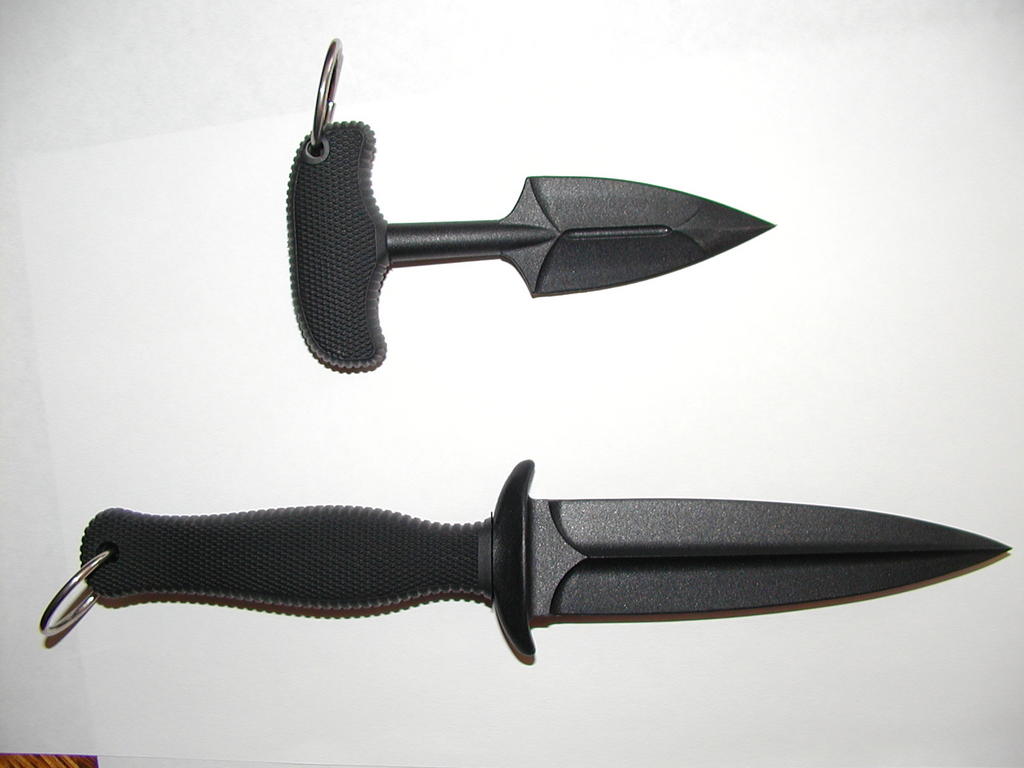
  • There are some cool (and frightening) knives out there. “Adventure” Collins went to the Cold Steal Challenge in Ventura last week and came home with a couple of interesting ones. These knives are made of composite materials (A fancy word for plastic). They are very sharp, pointy, strong and impervious to the elements. They’re also very light. I don’t know if their legal to carry, but they sure would be handy in a rainy or wet location since they won’t rust. Each has a required metal ring in order to make sure they are detected by a metal detector. However, the ring can be removed easily. My understanding is that these knives are instantly illegal once you remove the metal ring. It’s precisely because of these kinds of sneaky weapons that I carry my cane when I fly (and why I am grateful for Air Marshals). Honest folks will use these appropriately and should have the right to do so. Nevertheless, if you’re in law enforcement, be aware of these. If the ring is removed, metal detectors won’t pick them up.

* Stick / Cane

  • The simple truth is you cannot carry a gun or knife in many places, but you can carry a cane anywhere at anytime and stick type implements are all over the place. For example: the big Maglite flashlight in your car’s glove compartment is a stick. Your tire iron is a stick. A broom handle is a stick and so on.
  • For Cane: check out Cane Masters at http://www.canemasters.com/. I am a member of the Cane Masters International Association as is “Adventure” Collins. I own several of their canes and take one with me everywhere I go (even on the airplane). I’m almost 50 years old, so no one asks me about it. Between the Cane Masters system and my Arnis instructor, I have really learned how to use this weapon.
  • You can learn some great stick (and knife) technique from Hock as well. Check out the website at http://www.hockscqc.com/.


No matter what weapon you select, make sure you know how to use it and the consequences of doing so. This is part of being a responsible martial artist.

Friday, September 16, 2005

Some great books on self-defense, martial training, etc.

By Joel Persinger

Someone asked me recently which books or authors I recommend. Well, here are a few. I’ll give you a longer list at another time.

• Anything by Loren W. Christensen http://www.lwcbooks.com/. The dude has been there and done that. I have a couple of his books and will buy more. The two I have so far are “Fighter’s Fact Book” and “Solo Training”, but all of them are good.

• Anything by W. Hock Hochheim http://www.hockscqc.com/. Mostly he has videos with workbooks, but everything this guy teaches is on the money.

• Zen in The Martial Arts by Joe Hyams. This is a little book on the lessons Mr. Hyams learned as he traveled the martial road. It won’t teach you how to fight, but it will teach you how to think and act.

• Karate-Do Nyumon by Gichin Funakoshi. Master Funakoshi shares considerable wisdom in this little book.

• Tao of Jeet Kune Do by Bruce Lee. Mr. Lee’s thinking is fascinating to read. He brings a unique perspective to the fighting arts. It's both refreshing and challenging.

• The Dao of Taijiquan by Jou, Tsung Hwa. This is a book for someone who really loves the internal Chinese art of Taijiquan. It’s for someone who wants to understand the philosophy, history, forms and application of practice such as push hands, core training, breath training and so on. It’s a tough read if you’re not really interested in this stuff. But, if you are, Jou, Tsung Hwa was the foremost authority on Tai Chi of any family and the founder of the "Tai Chi Farm". Unfortunately, he was killed in a car accident a few years ago, but his wisdom, research and knowledge are still here for us in this and other books.

If you have a favorite martial arts book, please let me know. I’d love to read it.

Wednesday, September 14, 2005

Who Do we train to Fight.

"Remember, you train not just to know how to fight, but you train to learn how you will be attacked. Most of the attacking population is untrained. Another portion is poorly trained. The next and smallest segment is properly trained. Make fun of kick boxing or pressure point fighting, or high school wrestling, or joint locks? You should know what they know, to know what to expect.

Three classes of fighters...
- Untrained and poor fighters
- Instinctively good, yet untrained
- Properly trained "

By: Hock

What Do You Hit With What? ...What?

By Joel Persinger

I try to stay away from “rules”, but here’s one anyway. When striking an opponent with parts of your body (hand, foot, elbow, knee, head, etc.) it is generally better to hit hard targets with soft things and soft targets with hard things. At this point you’re probably asking yourself what kind of stuff I’ve been smoking. We’ll, I haven’t been smoking anything, I’ve just hit a few people in my life and learned how to do it without breaking my hand or foot.

So, here’s what I’m talking about. If you’ve been in martial arts for any period of time you’ve probably been taught to launch back fists, punches and so on at people’s faces, jaws, temples and the like. You may even have been taught the ubiquitous head but. Well, I’m here to tell you “don’t do it”. Hitting some dude in the head with your fist is like hitting a bowling ball. The chances are good that it will hurt you much more than the bowling ball (head). Head butting is just as bad. It works well in the movies, but in real life, more times than not the one issuing the head but ends up just as hurt as the one who received it. Imagine, taking two bowling balls and smacking them together. Crunch! Nobody wins.

God created your head with lots of strong bone to protect the little gray cells inside that keep you thinking. In fact, your head is one of the best protected parts of your body. Let’s face it, we don’t call each other “hard headed” for nothing. So, if you’re going to whack some guy up side his head because he’s attacking you, do it with a club if you have one (just recognize that you might kill him in the process). If you don’t happen to have a club at the ready or the situation doesn’t justify killing your attacker, drill him hard with a palm strike or three. Just as God put lots of bone in your attacker’s head, he put lots of pad on your palm. With palm strikes you can splash his brain around in his head, snap his jaw around sideway or send his noggin flying up and back so hard he won’t know his own name, and you can do it without breaking your hand in the process. The other nice thing about palm strikes to the head is that they stick to what you hit. Try this (gently please) with a friend. If you punch someone in the jaw or head with your fist it will glance off just after impact. However, if you strike the same areas with the palm it tends to stick and follow through. Try it a couple times and you’ll see what I mean.

The reverse of this is to strike soft targets with hard things. Some examples would be; striking the eyes (finger and thumb strikes mostly), throat, neck, solar plexus, stomach, kidneys, groin and so on. These are places where hard objects like fists, ridge hands, sword hands, elbows, heals and knees can strike with devastating results. Try this line of thinking in your practice this week. Hit hard things with soft and soft things with hard. It might change your approach to what you hit with what.