In an effort to improve the level of training I offer to my students, I have formed a partnership with Practical Defense Systems. PDS has a long history of providing high quality self-defense instruction to people who are simply interested in keeping themselves and their families safe. To find out more about PDS, visit their website at www.practicaldefensesystems.com.
Our Firearms training has been improved as well with the addition of a new arrangement with Project 2000 Shooting Range. Project 2000 is a terrific facility in East San Diego County. They have excellent indoor and outdoor ranges including: an indoor pistol range, an indoor 100 yard rifle range, an outdoor training range and both 5 Stand and Trap ranges for shotgun shooters. Also important to us is their fully functional classroom with multimedia technology. You can visit the Project 2000 website at www.project2000range.com.
Many of our firearms classes will be held at Project 2000 in the future. All classes are taught by NRA Certified Firearms Instructors. Check out the NRA classes that are currently available by looking at the class schedule on the right side of this website. We will add more to the schedule the very near future, so stay tuned!
Wednesday, August 12, 2009


Friday, June 12, 2009
A Nation of Sissies
By Joel Persinger
Nothing brings out the sissies like being injured. Whenever I have a martial arts related injury, the sissies seem to come out of the woodwork just to gawk at me with pained expressions on their faces and to say, “That looks like it really hurts.” I don’t mind when women do such things, but when men do it I begin to wonder about the state of manhood in this age. For the record, my wife is NEVER flustered by my injuries and my daughter always thinks they’re cool. This just goes to show that many women are stronger souls than all of you sissified men out there.
So, what am I talking about? I broke some bones in my hand in a training accident a few months ago. I was attending a “Unity Gathering” of Filipino martial arts practitioners and their instructors. The event was the third or fourth of its kind and was designed to help bring the various Filipino martial arts families together. This is a big deal because Filipino martial arts groups have been deadly rivals as far back as anyone can remember. It was a terrific day, I learned a lot of great lessons and I made some great friends. The one thing I received that I was not planning on was a broken left hand.
The broken bone in my hand was a result of a full power stick strike during training. It was a complete accident and was treated as such. The Guru who injured me was quite humble about it and I just figured it was time to move on and get back to training. It should be said that I expect to get hurt during training. That’s why they call it fighting. When you’re practicing fighting, you sometimes get hurt.
As it turned out, my hand still worked well enough to continue training. I was still able to grasp my sticks and I was still able to use my left had as a “check hand” even though it was broken. So, we trained for the rest of the day and I put some ice on it whenever we took a break. Since the gathering was during the weekend, I called the doctor to make an appointment the following Monday.
The hand was indeed broken. It required two hours of surgery and a metal plate to reconstruct it. It’s been seven weeks since the surgery as of this writing and my hand is back to about 75% and will be 100% in another month or two. No harm, no foul. I just spar with my broken hand tucked into the back of my pants. This is what I did this past Monday when Guru Greg Moody (one of the three elders in Cannibal Combat) and I traded sticks in my bac k yard. Greg is a touch fighter and a man whom I can truly call my brother in arms. Between Guru Greg and Guru Mike Ritz I found myself being hit quite a few times and left the day with a complete collection of bumps and bruises like the one on my right arm (Pictured here).
[by the way, this is nothing. Greg has more cuts, stabs and broken bones as a result of training and fighting than anyone I have ever known. Mike has quite a collection as well]
Two days later I went to the doctor for a check up on my hand. She noticed the bruising on my right bicep and said, “You need to get a new hobby.” I told her, “It’s not a hobby.” Later that day one of my employees came into my office. When he noticed the bruises he winced and said, “Why do you do that?” He went on to tell me that he didn’t like pain and could never imagine himself doing such things. I wish I could say that these responses are unusual, but they are not. These are the same types of responses I get every time I am injured.
People do not like the idea of experiencing anything that might be unpleasant and they simply do not see the value in the struggle of life. As a result, martial arts schools have dumbed down fighting by employing every kind of pad and protective gear they could possibly imagine and by turning every martial style into a point sparring sport. People won’t come if they think they might get hurt. But, they WILL pay to experience the thrill of fighting as long as there is no risk of pain or injury. That’s why most successful movies, TV shows and video games incorporate a large helping of violence.
This “risk free” thinking has gone well beyond the training of men to fight. It has become part of our every day existence. Consequently, I have come to the conclusion that we live in a land of sissies. We want the government to feed us, protect us, pay our doctor bills and keep us comfortable in our old age. Like the employee who commented on my bruises, we don’t want to feel any pain. We would much rather plop on the couch and live our lives vicariously by watching the adventures and struggles of mythical characters from our safe position at the opposite end of a remote control. Well, my dear reader, not I! I’ll live my own adventures and fight through my own struggles, thank you. I’ll be responsible for myself, pay my own way, feed my own family and when trouble comes, if it does, I pray that God will be merciful to the one who brings that trouble to my door, because I won’t be.
Do you hear the call of Manhood as I hear it? If so, then I will leave you with the salute that Guru Greg Moody always gives before a fight, “Courage, Strength and Honor.”
Nothing brings out the sissies like being injured. Whenever I have a martial arts related injury, the sissies seem to come out of the woodwork just to gawk at me with pained expressions on their faces and to say, “That looks like it really hurts.” I don’t mind when women do such things, but when men do it I begin to wonder about the state of manhood in this age. For the record, my wife is NEVER flustered by my injuries and my daughter always thinks they’re cool. This just goes to show that many women are stronger souls than all of you sissified men out there.
So, what am I talking about? I broke some bones in my hand in a training accident a few months ago. I was attending a “Unity Gathering” of Filipino martial arts practitioners and their instructors. The event was the third or fourth of its kind and was designed to help bring the various Filipino martial arts families together. This is a big deal because Filipino martial arts groups have been deadly rivals as far back as anyone can remember. It was a terrific day, I learned a lot of great lessons and I made some great friends. The one thing I received that I was not planning on was a broken left hand.
The broken bone in my hand was a result of a full power stick strike during training. It was a complete accident and was treated as such. The Guru who injured me was quite humble about it and I just figured it was time to move on and get back to training. It should be said that I expect to get hurt during training. That’s why they call it fighting. When you’re practicing fighting, you sometimes get hurt.
As it turned out, my hand still worked well enough to continue training. I was still able to grasp my sticks and I was still able to use my left had as a “check hand” even though it was broken. So, we trained for the rest of the day and I put some ice on it whenever we took a break. Since the gathering was during the weekend, I called the doctor to make an appointment the following Monday.
The hand was indeed broken. It required two hours of surgery and a metal plate to reconstruct it. It’s been seven weeks since the surgery as of this writing and my hand is back to about 75% and will be 100% in another month or two. No harm, no foul. I just spar with my broken hand tucked into the back of my pants. This is what I did this past Monday when Guru Greg Moody (one of the three elders in Cannibal Combat) and I traded sticks in my bac
 k yard. Greg is a touch fighter and a man whom I can truly call my brother in arms. Between Guru Greg and Guru Mike Ritz I found myself being hit quite a few times and left the day with a complete collection of bumps and bruises like the one on my right arm (Pictured here).
[by the way, this is nothing. Greg has more cuts, stabs and broken bones as a result of training and fighting than anyone I have ever known. Mike has quite a collection as well]
Two days later I went to the doctor for a check up on my hand. She noticed the bruising on my right bicep and said, “You need to get a new hobby.” I told her, “It’s not a hobby.” Later that day one of my employees came into my office. When he noticed the bruises he winced and said, “Why do you do that?” He went on to tell me that he didn’t like pain and could never imagine himself doing such things. I wish I could say that these responses are unusual, but they are not. These are the same types of responses I get every time I am injured.
People do not like the idea of experiencing anything that might be unpleasant and they simply do not see the value in the struggle of life. As a result, martial arts schools have dumbed down fighting by employing every kind of pad and protective gear they could possibly imagine and by turning every martial style into a point sparring sport. People won’t come if they think they might get hurt. But, they WILL pay to experience the thrill of fighting as long as there is no risk of pain or injury. That’s why most successful movies, TV shows and video games incorporate a large helping of violence.
This “risk free” thinking has gone well beyond the training of men to fight. It has become part of our every day existence. Consequently, I have come to the conclusion that we live in a land of sissies. We want the government to feed us, protect us, pay our doctor bills and keep us comfortable in our old age. Like the employee who commented on my bruises, we don’t want to feel any pain. We would much rather plop on the couch and live our lives vicariously by watching the adventures and struggles of mythical characters from our safe position at the opposite end of a remote control. Well, my dear reader, not I! I’ll live my own adventures and fight through my own struggles, thank you. I’ll be responsible for myself, pay my own way, feed my own family and when trouble comes, if it does, I pray that God will be merciful to the one who brings that trouble to my door, because I won’t be.
Do you hear the call of Manhood as I hear it? If so, then I will leave you with the salute that Guru Greg Moody always gives before a fight, “Courage, Strength and Honor.”
Wednesday, December 10, 2008

Hicks Law?
Reaction Time In Combat? No!
By W. Hock Hochheim
Action beats reaction. If you are reacting to an attack, as the good guys generally are, you are already behind the action curve. How behind, scientists have labored intensely to discover over the last 50 years, and like splitting the atom, they have split the single second into one thousand parts to do it.
It was about 25 years ago when I attended a police defensive tactics course and was rather insulted by the attitude of the instructor. We were treated like Neanderthals. He declared, "KISS! Keep it simple, stupid. Hick's Law says that it takes your mind too long to choose between two tactics. Worse with three! Therefore, I will show you one response." I wondered then and there, "Am I to stay simple and stupid my whole life? Who is this Hick and what is his law?"
And, it takes too long? How long was long? How long is TOO long? I wondered? We learned one block versus a high punch that day. What about against a low punch, I thought? My one high block fails to cover much else but that one high attack.
Later that evening while coaching my son's little league baseball team, I saw this very instructor coaching his boy's team on another ball field. He was teaching ten year-olds to multi-task and make split-second decisions as his infielders, worked double plays with runners on base. It was clear the coach expected more from these kids than he did from we adult cops that morning. Hick's Law was not to be found on that kid's diamond.
Next, I slid both feet into this thing called Hick's Law, to discover it was a growing favorite among law enforcement trainers. Other famous police trainers kept mentioning Hick's Law :
" - lag time increases significantly with the greater number of techniques."
" - it takes 58% more time to pick between two choices."
" - it takes 'about a second' to pick a tactic."
"Selection time gets compounded exponentially when a person has to select from several choices- "
What is the definition of "significant time?" 58% of what? What exactly is "about a second?" Exponentially? Compounded? I had to delve even deeper into these cavalier statements. They seemed to have an agenda. The agenda was to sell training courses and dumb-down people and training? If I was going to become this pessimistic, I needed more proof. I hit the textbooks and contacted the experts.
The actual Hick's idea was based on a computer study, a paper written in 1952 and simply set up an equation that states it takes time to decide between options. Just for the record, the equation is TR+a+b{Log2 (N)}. A computer performance study? Do you think that 1950 computers ran a bit slow? The 1950 idea was then extrapolated into human performance, based on very primitive, 1950 push-button tests. The lab method had the testee selecting from several buttons on sudden command. From this, the mythology of the slow decision making brain developed.
Exponentially decision making? Any exponential function is a constant multiple of its own derivative. Many modern tactical instructors still just blindly associate a never-ending doubling ratio to Hick - that is, for every two choices, selection time doubles per added choice. Yet, despite all these quotes on times, Hick made no official proclamation on the milliseconds it takes to decide between options.
There is a general, consensus in the modern Kinesiology community that Simple Reaction Time, called SRT, takes an average of 150 milliseconds to decide to take an action. That's considerably less than a quarter of a second-or 250 milliseconds, or half-a-second, or "about a second." Lets re-establish that there are 1,000 milliseconds in one second-a fact that makes all these time studies fall to include into a proper perspective. 1,000 of them! More than 1,000 milliseconds passed before you can read the number aloud.
Based on the doubling/exponentially rule with the commonly discussed SRT average, then choosing between two choices must take 300 milliseconds. Run out that time-table. Three choices? 600 milliseconds. Four choices? 1 second and 200 milliseconds. A mere five choices? 2 seconds and 400 milliseconds! Six? 4 full seconds and 800 milliseconds. Should a boxer learn 5 tactics? That would mean 9 seconds and 600 milliseconds to choose one tactic from another? You would really see people physically shut down while trying to select options at this point and beyond. Has this been your viewing experience of a football game? Basketball? Tennis? Has this been your experience as a witness to life? Under this casual, exponential increase rule, it would seem athletes would stand dumbfounded, as index cards rolled through their heads in an attempt to pick a choice of action. Every eye jab could not be blocked if the blocker was taught even just two blocks. The eye attack would hit the eyes as the defender sluggishly selects between the two blocks.
One then begins to wonder how a football game can be played, how a jazz pianist functions, or how a bicyclist can pedal himself in a New York City rush hour. How does a boxer, who sees a spilt-second opening, select a jab, cross, hook, uppercut, overhand, or to step back straight, right or left? If he dares to throw combination punches how can he select them so quickly?
Simple, modern athletic performance studies attack the doubling rule, but we need not only look to athletes. How can a typist type so quickly? Look at all the selections on a computer? 26 letters-plus options! How can you read this typed essay? How can your mind select and process from 26 different letters in the alphabet? It is obvious that the exponential rule of "doubling" with each option, has serious scientific problems when you run a simple math table out, or just look about you at everyday life.
New tests upon new tests on skills like driving vehicles, flying, sports and psychology, have created so many layers of fresh information. Larish and Stelmach in 1982 established that one could select from 20 complex options in 340 milliseconds, providing the complex choices have been previously trained. One other study even had a reaction time of .03 milliseconds between two trained choices! .03! Merkel's Law, for example, says that trouble begins when a person has to select between 8 choices, but can still select a choice from the eight well under 500 milliseconds. Brace yourself! Mowbray and Rhoades Law of 1959, or the Welford Law of 1986, found no difference in reaction time at all, when selecting from numerous, well-trained choices.
Why all these time differences? In 2003, I conducted an email survey of 50 college university professors of Psychology and Kinesiology. It is crystal clear that training makes a considerable difference. Plus-people, tests and testing equipment are different. Respondents state that every person and the skills they perform in tests vary, so reaction times vary. One universal difficulty mentioned by researchers is the mechanical task of splitting the second in their testing - that is identifying the exact millisecond that the tested reaction took place. Many recorded tests are performed by under-grads in less than favorable conditions.
The test-givers themselves have reaction time issues that effect time recording! Milliseconds are wasted as the tester sees the testee react, then reacts with a stopwatch device, either estimating or losing milliseconds in their own reaction process. Common test machinery takes milliseconds to register a choice. Results can get vague and slippery within the tiny world of a single second. Documenting milliseconds in the 1950s was almost impossible even in the most sophisticated labs, yet modern instructors ignore modern research and use the 1950s numbers to base their training methodologies. But test-gathering technology is rapidly changing.

The KISS Method- not well thought out as a doctrine.
Many unintended messagesand consequences are involved.
Discoveries made in 1990s, decades after the 1950s Hicks law began, blowing the original, antiquated "mental rolodex/task selection" concept out of the water. The brain has a fast track! Below, researchers Martin D. Topper, Ph.D., and Jack M. Feldman, Ph.D. write about them:
"Currently, the best explanation is provided by psychologist Gary Klein in Sources of Power: How People Make Decisions. He's proposed that the human brain is capable of multi-tasking. Gary's theory works like this: A visual image is picked up by the retina and is transmitted to the visual center of the brain in the occipital lobe. From there the image is sent to two locations in the brain. On the one hand, it goes to the higher levels of the cerebral cortex which is the seat of full conscious awareness. There, in the frontal lobes, the image is available to be recognized, analyzed, input into a decision process and acted upon as the person considers appropriate. Let's call this "the slow track," because full recognition of the meaning of a visual image, analyzing what it represents, deciding what to do and then doing it takes time. Some psychologists also refer to this mental process as System II cognition. If you used System II cognition in critical situations like a skid, you wouldn't have enough time to finish processing the OODA Loop before your car went over the cliff.
Fortunately, there's a second track, which we'll call "the fast track," or System I Cognition. In this system, the image is also sent to a lower, pre-conscious region of the brain, which is the amygdala. This area of the brain stores visual memory and performs other mental operations as well. The visual image is compared here on a pre-conscious level at incredible speed with many thousands of images that are stored in memory. Let's call each image a "frame" which is a term that Dr. Erving Goffman used in his book Frame Analysis to describe specific, cognitively-bounded sets of environmental conditions. I like to use the word "frame" here because the memory probably contains more than just visual information. There may be sound, kinesthetic, tactile, olfactory or other sensory information that also helps complement the visual image contained within the frame - fortunately, the fast and slow tracks are usually complimentary, one focusing on insight, the other on action. Together they produce a synergistic effect that enhances the actor's chances of survival.
But even though these two tracks are complimentary, we know that some people seem to be much more skilled than others at integrating System 1 and System 2. These especially competent individuals seem to resolve critical situations and also adapt to rapid changes in those situations. They invent routines they have never before performed and act in a fluid, seamless manner without employing full focal awareness."
So at this point in our understanding, we have newer models discovered and developing that tell us something about how the brain can operate on two tracks at the same time, but we don't really have a good idea of how the two levels interact, except to say that the interaction is very fast and complex, and some people do it better than others. We really don't know everything we'd like to know. But we do know that specific types of training can help a person develop unconscious competence, and this is enough to make some suggestions about the kind of training that will help make relatively unskilled people more competent in finding solutions to potentially violent encounters.
And then this news on BDNF: Brain-Derived Neurotrophic Factor :
"If I had to make a signal that could write messages on the brain from the environment, that would be BDNF."
Scientists at Johns Hopkins and the National Cancer Institute have found a "missing link" brain chemical that rises and falls quickly in response to stress, fear or an upbeat mood, and then sculpts nerve circuits in the brain accordingly. Their report, on work done appears in the Dec. 21, 1999 issue of the Proceedings of the National Academy of Sciences (PNAS). Further, because research at Hopkins and elsewhere shows that BDNF levels vary with subject's experience as it goes down in stressful situations..."BDNF has all the right features to be the critical signal by which environmental and psychosocial interactions impact on the brain," says neuropathologist Dr. Vassilis E. Koliatsos. "It's very rapid, it's sensitive, and it affects a system critical for emotional life and behavior. "What we believe we've found is a link between what happens to a person on a daily basis and the way the brain responds, from an emotional standpoint, over the long term."
Dr Susan Greenfield has written The Quest For Identity In The 21st Century, in which she discusses the natural ways the human brain grows and adapts. " I'm a neuroscientist and my day-to-day research at Oxford University strives for an ever greater understanding - and therefore maybe, one day, a cure - for Alzheimer's disease. But one vital fact I have learnt is that the brain is not the unchanging organ that we once imagined. It not only goes on developing, changing and, in some tragic cases, eventually deteriorating with age, it is also substantially shaped by what we do to it and by the experience of daily life. When I say "shaped," I'm not talking figuratively or metaphorically; I'm talking literally. At a microcellular level, the infinitely complex network of nerve cells that make up the constituent parts of the brain actually change in response to certain experiences and stimuli. The brain, in other words, is malleable. The surrounding environment has a huge impact both on the way our brains develop and how that brain is transformed into a unique human mind.
Doctors Richard A. Schmidt (a decades long expert) and Timothy Donald Lee, in the , ground breaking, 1980s book and subsequent new editions since, Motor Control and Learning reported that task selection is made up of two parts, RT (reaction time) - seeing the problem, and MT (movement time) - physically moving to respond, and thus may be a "few milliseconds " for fast, simple chores, not this compounding, exponential, doubling, half-second format.
Eight decades of performance testing and technology have passed since Hicks simple, little "Computer Choice Law", with new technology and testing on athletes as well as regular, everyday people. Not only are the testing methods better, and the understanding superior, so are the new methodologies created to increase SRT and selection times. Perhaps no better better statement damning the Hicks law model can be found than from neuroplastician Dr. Michael Merzenich, regarded among experts as a leading source on the human brain when reporting in the book, The Brain that Changes Itself, "we can change the very structure of the brain and increase its capacity...unlike a computer, the brain is constantly adapting itself." You will recall that Hicks Law concept first originated from a computer.
How can we change and improve? With training like:
* Sequential Learning - the stringing of tasks working together like connected notes in music, really reduces reaction and selection time.
* Conceptual Learning - is another speed track. In relation to survival training, this means a person first makes an either/or conceptual decision, like "Shoot/Don't shoot," or, "Move-In/Move Back." Rather than selecting from a series of hand strikes, in Conceptual Learning, the boxer does not waste milliseconds selecting specific punches, but rather makes one overall decision, "punch many times!" The trained body then takes over, following paths learned from prior repetition training.
Sure, sure, sure - simple is good. I am all for simple. Absolutely. And reaction time is an important concern when you are dodging a knife, pulling a gun, etc. And there may actually come a point in a learning progression when there are way too many reactions/techniques to counter an attack, and If these moves are a bit unnatural, and not guided somewhat by natural reflex, and taught poorly and out of context, a long list of movements may cause performance problems. Poor systems and poor training may lead to untimely confusion. But we are surely not as simple as Hick's Law misleaders have warned us.
It seems like the last 8 decades, Hick's Law has become a legacy of evolving research. But, Hick's Legacy is really telling us to train more and smarter, not necessarily to be stupid and learn less. Remember one of Einstein's Laws apply also - "Keep it simple…but not too simple." I like the sound of that much better than stupid instructors KISSING me to keep things stupid. And still we learn more.
Dr. M. Blackspear of the Brain Dynamics Center at the University of Sydney Australia reports that the: "...study of functional inter-dependences between brain regions is a rapidly growing focus of neuroscience research. This endeavor has been greatly facilitated by the appearance of a number of innovative methodologies for the examination of neurophysiological and neuroimaging data." This Blackspear statement was made about the amazing new discoveries in 2005 and of how fast, repeat HOW FAST the healthy, human brain changes and adapts "on the fly" (which is the medical, catch phrase for such studies on this now). People select and change options "mid-flight" in milliseconds split into milliseconds.
6 Choices? 400 milliseconds to choose or a full 3 or 4 seconds to rolodex through all of them? Let's go back to the ol' ball game - and back to the baseball analogy that started this article. We expect a common shortstop in baseball to perform a select list of actions instantly. The baseball shortstop is expected to:
- catch a ground ball to his left
- catch a ground ball to his center
- catch a ground ball straight at him
- catch a line drive
- catch a pop-up
Moves all to be executed in the sheer "splitest" of split seconds? Then, our ape man ball player has even more split-second, follow-up decisions to make with runner's on different bases. Even a child playing shortstop has a lot to decide and fast, AND can do it faster than 4 seconds! I hope that the police trainer I mentioned in the beginning of this essay is reading this this and not just when he teaches his kids in little league, but when he teaches his adults in law enforcement tactics. In fact I hope all martial instructors are listening?
Probably the single reason Hicks Law has been spread in the last few decades is as a sales pitch to sell training programs. If you still insist on dumbing things down? Then don't use Hicks Law in your argument. It makes you sound dumber. The more the truth is learned? the dumber you will sound.
ANYONE quoting Hick's Law today as a main basis for training, needs to open up an elementary school science book written since the year 2000, to see it is a decrepit, misleading and unraveled concept. They need to know the rest of the science since the 1950s. Hick's Law has become barely a casual nickname, a sketch or an outline for the thousands of performance experiments in laboratories since 1952. The ironic thing is? The center piece and point of all this reaction research? Even since the 1950s it is really about milliseconds. Milliseconds! Remember, there are 1,000 milliseconds in a second! Just how fast can we get? Start by asking a properly trained person with a healthy mind and body, in a proper system abreast of cutting edge science, medicine and psychology. Don't ask Mr. Hick from the 1950s. If I am not mistaken? Mr. Hick is dead, and his 1950's computer belongs in the stone age.

Much more workable!
Monday, October 20, 2008
No-bama: Why I will not vote for Obama
By Joel Persinger
While I generally try not to engage in political opinion making on blogs, I feel it is time for me to speak out.
As a martial artist, a Christian and an American I hold the fundamental belief that each of us has a right to make our own choices, hold our own beliefs and live our lives according to them. I also believe that each of us has an obligation to take hold of the responsibility which comes with such freedoms. I believe that, in doing so, we must agree to accept the consequences of our actions. This is called freedom. We have the freedom to say and think and do, along with the responsibility to live with the consequences whether good or bad.
For example: If I work hard and apply myself, I have a chance to succeed materially in life. On the other hand, if I sit on my butt and do nothing, I have an equal opportunity to enjoy the fruits of my lack of labor. Likewise, if I achieve some measure of success such that I have a home in which family lives and some individual decides that robbing me is the best way to get ahead, then he must accept the consequences of his actions. If he enters my home in an attempt to steal or cause injury to my family or myself, it is only right that he accept the fact that I will probably injure or kill him as a result of the choice that he made.
The problem with Obama is that he believes the opposite. He believes in what I call, “assigned responsibility” or “AR” for short. Under the concept of “AR”, a person who makes poor choices in life does not have to accept responsibility or consequences. Instead, such a person simply elects to tag himself or herself “Victim” and then assign that responsibility to someone else. In some cases, the irresponsible person assigns his or her responsibility to the government. In other cases, the responsibility is assigned to other responsible people who have made good choices. “AR” is where Mr. Obama gets his philosophy of defending the criminal instead of the victim. It is also how he came to his belief that abortion is somehow a responsible act. The very idea that “free sex” with whomever, wherever and whenever should be without consequences and that the State and it’s citizens should somehow be responsibility for bearing the financial, moral and social costs of such behavior is, at it’s very core, “AR”. As if this were not enough to glean from the “AR” approach to life, Mr. Obama has also divined the policy of raising everyone’s taxes so that HE can decide where the money goes and who gets it. This is what he told Joe the Plumber was called, “Spreading the wealth around”.
Let me dispel one myth here and now. Obama will repeal the Bush tax cuts. Now, let it be known that, just like Joe the Plumber, I do not make $250,000 per year or even close to that amount. Still, I pay far less taxes as a result of the Bush tax cuts than I did before them. I am 50 years old, not 20. So, I do remember how much I paid in taxes and how much the Bush tax cuts helped my family. I was not a snot nosed kid at the time and I am not so old that I’ve lost my memory. I can’t be fooled on this one. So, make no mistake, when someone does away with a tax cut that lowered your taxes, your taxes will go up! Folks, that is called a tax increase on the middle class! So, the claim that Obama won’t raise taxes on 95 percent of the people is just plain bull-honkey! I don’t want to insult, but if you believe that a tax & spend liberal-socialist won’t raise your taxes, you are either a fool or an idiot.
So then, the reasons why I cannot and will not vote for Senator Obama and why I urge you to vote against him are:
1. If elected, he will take great joy in making me suffer the consequences earned by those who have NOT worked to succeed, by taking what I have been able to earn with my labor and “spreading the wealth around” to those who have NOT worked or earned as I have.
2. He will work diligently, as he has since the beginning of his political career, to remove any chance I might have to defend my family in my own home or anywhere else. He will make my firearms illegal, tax any ammunition I might need to purchase by an additional 500% (he has already tried to do this in the past) and he will make it illegal for me to defend myself or my family in my own home (something he tried to accomplish as a State Senator). Thus, in Obama’s America, if someone decides to enter my home for the purpose of robbing me or harming my family, I will go to prison if I try to stop him!
3. He will stand in lock-step with those attempting to stuff gay marriage down everyone’s throats and support the irresponsible and ungodly act of abortion.
So, as one who teaches self-defense and the use of firearms, one who is a small business man, and one who is a Christian who DOES NOT support gay marriage or abortion, I must vote for John McCain & Sarah Palin. If you feel as I do about any of these issues and you are thinking about voting for Obama, I urge you to throw some cold water in your face, wake up and vote for John McCain.
If you are an Obama supporter and don’t believe me, I challenge you to look at his record. He is a socialist and easily one of the most liberal members of Congress. He may butter you up with his words, but his actions tell the tale.
Tuesday, April 15, 2008
Techniques and Principles (Building upon a strong foundation)
By Joel Persinger
I am a great believer that techniques, without a deep understanding of principle, are useless. One simple example is this: if I don’t understand the use of kinetic energy, learning how to punch will yield punches which are weak and ineffective. Yet another example is that of body type and size. Say what you will, but in my world, size matters. It is an indisputable fact that techniques which work for a small person when combating an equally small person may not work as effectively when the little guy is trying to fight off a six foot, six inch, 350 pound hulk. Likewise, techniques which work for a person with a low center of gravity may not work as well for a person with a high center of gravity when applied against the same or a similar opponent.
In addition to the basics of physics, body style, age, relative agility and size there is also the issue of martial style. Techniques which fit well into one martial system may be cumbersome and unworkable when used within another. Thus my friend & instructor Mike Patterson’s analogy of building a car,
“Mixing and matching is analogous to grabbing a hodgepodge of car parts from different makes and models to build a working automobile. You might be able to build something that looks like a car but it will not run effectively, if it runs at all, simply because the parts are not made to work together.”
In today’s world of martial arts, mixing and matching has taken on a life of its own. Gee, one has to look no further than the term, “Mixed Martial Arts” to see the point. The result has been a significant “movement” creating folks who look like martial artists, but whose collection of techniques often does not work together effectively, or at least not as effectively as it might. Yes, a rear naked choke is a rear naked choke and a hip throw is a hip throw. But, when techniques are simply piled upon one another without any foundational guiding principle, there is no way for the practitioner to understand and evaluate what fits and what does not.
Now, before you get out your poison pen and start sending me hate mail accusing me of bashing mixed martial artists, let me make a few things clear. Not one martial style known today was created in a vacuum. All of them evolved over time as guiding principles were established and perfected and as techniques were explored and honed. It can also be accurately said that martial styles have borrowed from each other by taking parts of other arts which fit well into the system and, in many cases, adapting them further to make them fit even better. Since time is not static and since our ancestors did not freeze martial styles in place for all eternity, we shouldn’t either. We should learn from the example of those who came before us by learning from other arts thereby exploring new frontiers.
Where we have lost our way is not in that we have elected to bring new and different techniques into the fold. Rather, it is that we have forgotten to let the foundations of our arts guide us as we incorporate new ideas. For example: I have spent most of my history studying the Karate style arts. Along the way, I have studied internal Chinese arts a little and Filipino martial arts a lot. In fact, my first instructor taught a Karate style art with Arnis De Mano mixed in for good measure. As a consequence, the foundation for my martial arts journey was firmly built upon a mixture of Karate and Filipino Martial Arts. They are very different, and yet my first instructor was able to put them together so that they worked in unison. Thus, my foundation is different than most. But it is strong.
On the other hand, I have a student (who, by the way, teaches me too). He has been studying Hsing-I for twenty years or more. As I teach him the various aspects of Filipino Martial Arts he relates what he learns to his foundation. Consequently, his movement and his application of the techniques he learns from me are very different from mine. Some things which work well for me, will not work well for him and vice versa. Some things may work well for him only after he has adapted them to fit firmly upon his foundation. This is not because the techniques don’t work. It is because our foundations and the guiding principles upon which they were fashioned are different.
The bottom line is that learning new techniques is fun and very positive. However, there is a difference between collecting disjoined techniques as you might pile up unrelated car parts in a junk yard and carefully examining, honing and shaping new techniques to fit well upon your foundation, just as you might select premium, well fitting parts with which to build your car. I submit that that the latter approach will help you become a more complete martial artist, while the former may leave you only a collector of junk.
Monday, April 14, 2008
Tell your kids it is okay to fight
From CrossFitKids magazine
-Jeff Martin
We have been told for years that fighting is morally and ethically wrong. That it is never the answer. This belief has threatened our country’s security and now we see the effects it can have on our children. Fighting is not wrong in the cause of self-defense. It is not wrong for our nation to proactively protect itself nor is it wrong on a personal level to respond with physical force when threatened.
When I was young and in school a little boy hit me in front of the teacher. He was reprimanded and sent to detention. On the way out of school he told me he was going to do it again the next day. When I told my parents about the incident, they told me if he tried to hit me again, I was to hit him. Actually, they said hit him hard enough that he will never want to hit you again. I did and he didn’t.
A couple of years ago my wife went to pick up one of our boys at preschool. She found him hiding under a desk. When she asked him why he was hiding he said he was hiding from one of the other boys who had choked him several times that day. When my wife approached the teacher she was told that the boy “was having trouble at home and just acting out.” While I sympathize with the child who was having trouble at home, this was somehow supposed to excuse him attacking my son. That night we taught our son a simple Krav Maga self-defense technique. He in turn shared his new knowledge with his teacher. His teacher made it very clear to him that under no circumstances was he to defend himself. He was to get her attention instead (with a child’s hands wrapped around his throat) and she would take care of the problem. We of course relieved him of that notion.
Think of the different lessons these two stories teach. In the first, my parents taught me not only that I had a right to defend myself but that the responsibility for my safety rested with me. In the second, the opposite lesson was taught. My son was told his safety was someone else’s responsibility and under no circumstances was he to defend himself. If you have been taught the first lesson, you react instantly to someone threatening your safety. If you have learned the second, you look for an authority figure to help you when threatened. If there is no authority figure to stop the attack you waste valuable time deciding what to do and how to react. We are complicit in the victimization of children by predators if we are teaching children to look for an elusive authority figure for help.
A few months ago, we watched in shock, the video of poor Carly Bruscha simply allowing someone she doesn’t know to walk up, grab her arm and pull her away. She looks confused and frightened on the video. It takes only an instant for her abductor to move her out of the cameras eye. What a different video we might be seeing if at the instant she was touched by the man she launched into him biting, kicking and using everything she had to keep him away from her. I heard a retired FBI agent say, that they knew of no case where a child who was fighting back was killed in the course of an abduction. The reverse is not true. If abducted the outcome is almost universally bad.
On a news program this morning, they ended the story by saying there is “evidence the little girl fought her attacker to the end.” The problem is she didn’t fight in the beginning. Building good character goes hand in hand with a belief in the right to self-defense. Your children must know when and where to apply the defensive skills you teach them. That responsibility falls squarely on your shoulders and on theirs. If you build good character, then self-defense will be exactly that— defense. It will be a reaction to an act of violation, and every child has the right to defend himself if violated. Our children need to be given permission to fight. Yes, they ALSO need to be taught good judgment so they know when fighting might be wrong.
But to demand that children discard their moral right to protect themselves is a lesson that should not be taught in any school or in our society. Children need to know it is morally and ethically right to fight and defend themselves the instant they are physically threatened.
By Jeff Martin of Brand X Martial Arts & CrossFitKids
Tell your Kids it is okay to fight.
CrossFitBrandX.com
CrossFitKids.com
Brandxmartialarts.com
Sunday, April 06, 2008
"You are not stabbing me right!"
Rolling Skating in a Buffalo Herd
Recently, I was teaching an impact weapon class and observed an event I have seen a gazillion times between workout partners. One old hand. One new rookie. The experienced hand tells a brand new person how to properly hit him with a stick. Properly! Because his response "won't work" if the rookie didn't attack - properly. The new guy had some flimsy, wrong-wristed, amateur way to strike that was quite lame because he was new to the baton. Honestly, it does remind one of the old Jim Carry skit on the In Living Color TV show:
"You are not stabbing me right!"
But, the sad thing is, the new person was actually hitting his partner as he would in a fight. And sadder still, the vet partner was only prepared to fight against the proper veteran angle of a skilled fighter's delivery. The saddest point? That "wrong" way is likely to be how 90% of the population will actually attack you.
Want to see a new counter and response from a tactic or technique? Bring a new guy into your workout class. Man on the street. We can almost guarantee he won't attack you "the right way." Nor will he respond "the right way." He will squirm out of your joint locks. He will step in the direction of his fall and confound your takedowns. He'll pell instead of mell. Shuck instead of jive.
The new guy might punch funny, swing a stick poorly or deliver a weird, lame line of attack. He may will shoot you, and quite well, like a cowboy from an old black and white western. But he still shot you first. Martial history is replete with these stories of new people inflicting injuries on vets. Remember the story of the first-day, gangly teen-ager, who accidentally stuck his finger into the eye of a Brazilian black belt and put the veteran black belt out of commission for months?
Several issues for the veteran are at the core of this phenomenon. One is, what I have called for two decades now, the myth of the duel. Systems train against the mirror image of themselves and fight against the overt and the subtle methods of their system. It is an insidious little, cancerous problem. Like a tunnel vision, only it becomes tunnel-vision-fighting.
This mistake is easy to read and understand here, yet martial practitioners still suffer greatly at the hands of the radical and different. Conventional warriors suffer at the sneaky ways of the guerilla. The rule-abiding cop fights the no-rules bad guy. Kick-boxers suffer at the hands of ground fighters. Wrestlers suffer at the hands of ground n' pounders. Firearm-range, paper-target shooting champions suffer at the rabid, trigger finger of the alleyway thug. The boxer never sees the hammer fist. This bloody list of interdisciplinary mistakes is almost endless. Train to fight the enemy you expect.
Second, remember not just to train in a multi-disciplinary manner but to fight against these so-called, "rookie/wrong-ways" of common attack. These are high-percentage probabilities.
Year-after-year your fighting system, your rules of engagement, engrains itself into your muscle memory. You become use to the lines and methods of hand, stick, knife and gun attack that your system delivers. Then someone spits in your eye and hits your head with a frying pan. Wait now - what belt level was that again?
By Hock
(Taken from March CQC Dispatches)
http://hockscombatforum.com/index.php/topic,3747.msg32675.html#new
Tuesday, November 20, 2007
"It's what's inside that matters most"
Perhaps far more important than the confidence in one's ability to defend oneself is the confidence in that one is living a life that's purpose is worth defending.
Indeed, while self defense training may make you an audacious foe, woe be it to any man who attacks another who's life is not just deeply rooted in purpose, but a purpose much larger than himself. For such a man, winning is no longer a matter of skill, it is a moral imperative.
If this purpose is buttressed with the knowledge of how to defend it, a more dangerous man than this, you will not find.
Posted by Jared F. Boasen
Saturday, July 07, 2007
Hands Wanted!
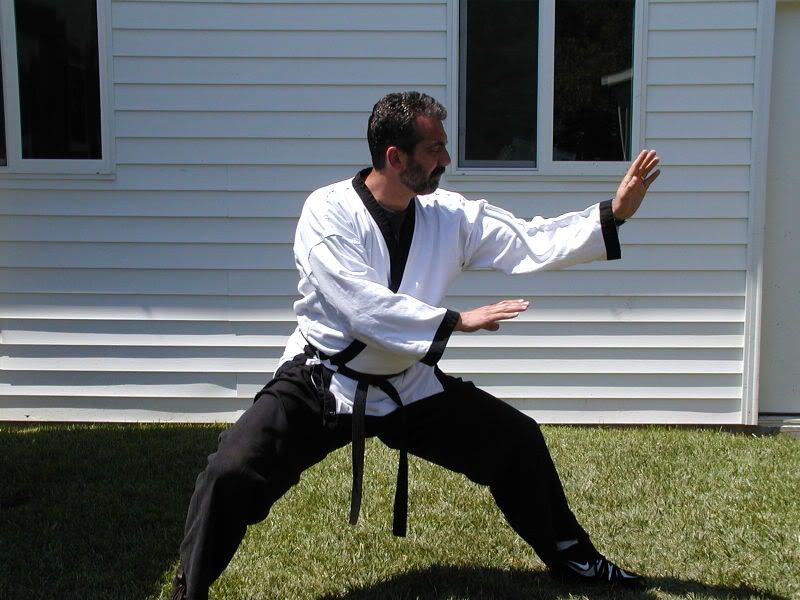 I will probably get myself in trouble again by saying this, but I am continually amazed by the fact that many martial arts classes I have attended or visited seem to teach students a disproportionate use of the feet and legs in self defense.
While it is true that a human being's legs are much larger and stronger than the arms, it is not appropriate in my estimation to leave the hands and arms out of the picture.
Not long ago, I attended a class in WTF Tae Kwon Do. I should stop here and clarify that I have nothing against Tae Kwon Do. I studied it for years and learned great lessons in the process. One of the instructors I respect most is Master Stegall who is a 6th Dan in ITF Tae Kwon Do. I go out of my way to learn from him at every available opportunity. Having cleared that up, I can get back to my story.
I was attending this class and was given the opportunity to do some sparring with one of the instructors. He was a great guy and lightning fast with his feet. It became quickly apparent that my best chances for survival could be found in either running away or getting in close. Since I was all dressed up in my fancy Japanese pajamas (Martial arts uniform) I couldn’t very well run away. So, I took the first opportunity to bridge the distance and move in close. I got my grubby little hands on him and proceeded to put him on the mat. He had kicked the snot out of me in the proceeding 30 seconds, so I thought landing his rump on the mat was the least I could do.
He was very gracious about it all. He got up with a smile and we started again. Each time we clashed, I found my safety zone inside his powerful kicking range. He found his at the extension of his kicking power. He was twenty or so years younger than me and easily twice as fast, but I found that I could still manage to land a kick or two if I chose my opportunities carefully. The problem for him was that he didn’t have any hands. I don’t mean that literally. The man possessed hands; he just didn’t know how to use them effectively. By all rights, he was nothing but lightning fast feet.
Because of this out of balance approach to his training, I was able to take advantage of his weakness. I stayed close. Sure, he could still execute those cool rubber band Tae Kwon Do close up kicks, but they didn’t help him. I was too close and the moment he lifted a foot off the mat, his center of gravity was broken and down he went with a little help from me.
After the sparring match, he and I talked a little. He told me that he focuses on tournament competition and the rules of such things forbid clinching and throwing. As a consequence, his training has consisted of 90% kicking techniques and only 10% hand use. I listened and kept my comments to myself, but I will share them with you now.
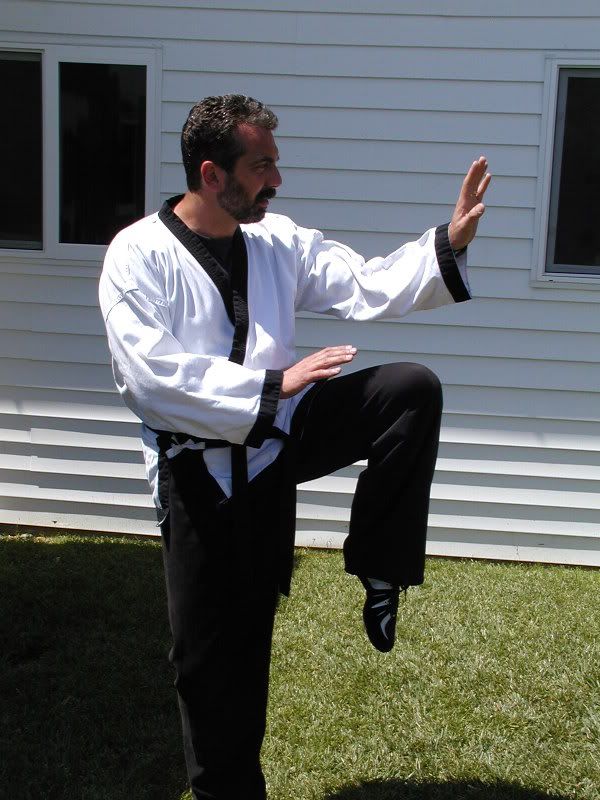
The human body has many parts and many potential tools that can be used in self defense. Among these are hands, arms, legs and feet to name only the obvious. The idea of summarily eliminating 50% of your tools from the tool box is foolish in the extreme.
While I understand that some martial styles have been converted from “martial” arts to “sport” arts, it is important for the student to understand the difference. Sport arts are perfectly legitimate for a sporting application in competition. However, they are not entirely adequate for self defense.
To clarify the glaring difference between the two, we must define the words in questions. The word “martial” is defined by Webster’s New World Dictionary as follows: “Of or suitable for war.” By contrast the word “sport” is defined as, “Any activity or experience that gives enjoyment or recreation.” While I enjoy studying, practicing and teaching martial arts, that which I study and teach is “of or suitable for war”.
So, if you’re hunting for a martial arts class to attend, my advice is to determine where your focus will be before you start. The best way to determine this is to be honest with yourself when you look in the mirror and ask, “Why do you want to learn a martial art?’ Your answer will determine whether “sports” instruction or “martial” instruction are right for you. It should be noted that many martial styles have both sports focused and martial focused sub-styles. Tae Kwon Do is just one example. Whichever you chose, be sure to remember the limitations of the instruction you have chosen and for goodness sake make sure you learn the use of your hands.
Monday, January 01, 2007
Demo Videos Are Finally Here!
 We put together these video clips so you could see us demonstrate for a class. We hope you enjoy them. Instructional videos are not far behind, so if you have a specific subject you would like to see a video on, please let us know.
Click on the following links to visit the videos:
Thursday, December 14, 2006
Spoof Self Defense Video
It's easy to take things too seriously. This video from derrickcomedy.com pokes fun at self defense instruction. Both David and I got a kick out of it and I'm sure you will too.
Watch the video
Watch the video
Monday, December 11, 2006
Seminar put on by David's favorite instructors

There is a seminar coming later this month in Sacramento, put on by the scientific fighting congress. Classes are NOT presented by the Stay Alive Program, but the instructors are well known and have some great things to teach. David will be attending this seminar, so if you would like to go you will probably see him there.
Contact the seminar promoters directly for information.
The promotional information that was posted on the promoter's website is copied here for your information.
Gun Fighting, Hand to Hand Combat, Stick Combat, Knife Combat for Police, Military and Citizens
Seminar- Jan 25-28 CQC Group, Sacramento, CA $400.00
This is one the few CQC Camps this year!
You must come to this one! Hand, Stick, Knife and Gun Close Quarter Combat Camp. Your Next Rank Requirement, Tactics plus other great skill and knowledge drills. Rank and instructorship advancement opportunities, Or just train for knowledge.
All skill levels welcome.
Gun-Thursday,
Hand-Friday,
Impact weapon/stick-Saturday,
Knife-Sunday (There may be some overlap as we try to squeeze in the requirements)
HOST:
CMS Martial Arts Center
6240 Greenback Lane
Citrus Heights, CA 95621
(916) 768-3933
10am to 5pm each day.
4 days $400. 3 days $300. 2 days $200. One day $100.
www.conflictmanagementsystems.net
Please wear street clothes and mat shoes or footwear suitable for wearing on training mats. Bring eye protection, a replica pistol, knife and two sticks, and two focus mitts. If you do not have these, some will be available for borrow or sale. If you have a battery-powered airsoft pistol, please bring it.
Special Guest Instructor Jim McCann who will teach ground tactics with and against hand, stick and knife. http://www.xtremefreestyle.com
Email Hock at HockHoch@aol.com and ask for other topics to be taught for your personal progress!
Traveling in from afar? Your group may qualify for a great, group discount. Contact Hock.
HockHoch@aol.com
Tuesday, October 31, 2006
Tactics & Strategy

By Joel Persinger
Everywhere I turn, I am bombarded by the words “tactics” and “tactical”. Every folding knife is a tactical blade. Every new firearm has a “tactical” version or some new “tactical” attachment. Surefire has all of its “tactical” flashlights. Every mixed martial arts school in the world is “tactical combat” this or “combat tactical” that. We are so overcome by the marketing of “tactics”, that we have forgotten something just as important. In fact, what we have forgotten may be more important. It is called strategy.
The problem is, there isn’t much money in selling a “strategic” knife, firearm, attachment, flashlight or class. That’s because strategy happens in your head and on paper. It requires serious forethought, planning and execution to develop and implement a working and successful strategy. None of which gives us the chance to punch, kick, stab, slice or shoot our way into feeling like James Bond or Chuck Norris. But, it just might be the ticket to keeping us and our families safe.
So before we go any further, let’s define both strategy and tactics. Strategy, according to my handy Webster’s dictionary is defined as “the science and art of employing the political, economic, psychological, and military forces of a nation or group of nations to afford the maximum support to adopted policies in peace or war” and “the art of devising or employing plans toward a goal”. Tactics on the other hand are defined as “a method of employing forces in combat” and “a device for accomplishing an end”. So then, strategy is the over all plan and tactics are the specific means and tools used to execute the plan. This explains why nobody is selling a “strategic” knife. A knife, being a tool with which to achieve an end, can only be tactical.
For the sake of argument, let’s say I have purchased my tactical knife, tactical firearm and my tactical accessories and flashlight. I’ve even taken my “tactical combat” classes and I took some “combat tactical” classes just in case the first instructor had it backwards. I’ve gotten my concealed carry permit, so I can carry all this stuff and I’m ready for anything! Bring on the fight! I can take on the devil himself and defend my family, no bones about it! And when I go to bed at night, I stack all this crap next to my bed in the sure and certain hope that, when somebody busts through my flimsy front door or my paper thin windows in the middle of the night, I’ll be ready!
Sounds kind of silly doesn’t it? But, silly or not, it’s all too common an approach to the problem of personal and family security.
Now, before you get your knickers in a knot, let me be clear about a couple of things. I own a tactical knife, firearm or two, a tactical flashlight and some accessories. I’ve studied single combat in the form of traditional martial arts, firearms training and various “combat” & “tactical’ seminars for years. There is nothing wrong with doing any of those things and I applaud you if you have done them. However, developing the means to execute a plan without ever developing the plan is a fool’s errand in the extreme.
It should also be noted that “self defense”, the process in which all this “tactical” stuff would be employed, is only one part of personal security. Actually, it is the part that is employed as a last possible resort and, in most cases, the least often used. It’s just the most exciting, which explains why it sells! Nevertheless, a personal security strategy has many components: deterrents and provisioning to name just two. Like a mission statement for a business, your personal security strategy does not need to be complicated and can be stated quite simply. Here is the personal security strategy we have adopted in my family:
- In order to provide for the security of our family, we will take steps to make our home, our surroundings and ourselves less attractive as potential targets to criminals.
- We will acquire the training and tools necessary to defend against criminals should they not be deterred.
- We will provide for the event of a natural or man made catastrophey by preparing and storing supplies and equipment, preparing to defend our home against criminals who might take advantage of such an emergency and providing for evacuation should it be necessary.
The strategy written above is simply a general overview of the steps we planned to take and the attitude with which we have approached the problem of personal security. Once we had a strategy, we began to implement it by employing the tactics or means necessary. For example:
In order to make ourselves, surroundings and home less attractive to criminals we have employed the following tactics:
Our home:
- Lights, lock & landscaping. Our house is well lit at night, we have good, solid locks. Our doors and windows are of good quality. Our landscaping is properly trimmed so that criminals cannot hide behind it.
- We installed a monitored alarm system in our home, with the stickers and sign to warn off criminals.
Our surroundings:
- We do not associate with trouble makers.
- If we know trouble exists somewhere, we do not attend.
- We have all been trained to be more aware of surroundings and to make good choices.
Ourselves
- We follow our training in the three “A’s”. Awareness, Attitude, Avoidance.
Most criminals will be deterred by the tactics listed above. However, if they are not, we have the training, skills and tools in place to address the threat and eliminate it. The nice thing is that, because we have adopted our strategy, the chances of our ever having to take such drastic steps are significantly reduced. This, after all, is the goal. If we are the good guys, and we are, then we must take those steps necessary to avoid trouble whenever and where ever we can.
Therefore, as you travel on your martial arts journey, remember that martial skill is only a small part of personal security. The tactical is more glamorous, exciting and fun. But, the strategic is vital, if we are to first define and then achieve our goal. You need not take my word for it. I think Sun-Tzu said it best, “Strategy without tactics is the slowest route to victory. Tactics without strategy is the noise before defeat.”
Wednesday, October 25, 2006
Just when I think I have it all figured out…
 By Joel Persinger
The last couple of days have presented an opportunity for me to put the little gray cells in my head to work and to practice the humility I’m always preaching and not always very good at.
I had a discussion via email with Shrfu Mike Patterson of the Hsing-I Martial Arts Institute http://www.hsing-i.com/. Shrfu Patterson is my Kung Fu instructor (a man for whom I have enormous respect as a person and as a martial artist. And besides, I just like him). He was kind enough to check out this blog and offer his input.
If you are a regular visitor to the site you may notice changes that came about as a result of his advice. There is a mission statement, the links on the right have been changed and organized (we still have a ways to go with that) and we have clarified our focus by informing you that some articles on the site are placed there for the purpose of sparking discussion even though they may not be in line with our mission. From time to time we may post such articles because they represent common arguments we need to address or simply because they’re thought provoking.
In addition to helping with the website, Shrfu wrote some other things that really got my mind churning. In fact, I am still thinking through them. I thought you might find them interesting as well. Here are some excerpts:
On the subject of “basic self defense”
There is an old saying of which I am sure you are familiar; "A little knowledge is a dangerous thing". I don't believe that there exists a set of "basic skills necessary to defend..." period. What I think can be valuable are some of the other things you mentioned; Awareness of what could be a threat and how to avoid them, Basic negotiation tactics and habitual perspectives on the potential of violence, etc.
Response to physical violence requires a great deal of training. The reality of what actually happens is almost always misconstrued and misunderstood by those that would teach "self defense". My experience tells me that the approach does not work and can actually breed a false confidence in the "self defense" student that can get them into serious trouble. Actual physical self defense is best left to experts, not amateurs.
The more I think about this, the more I tend to agree with it.
In answer to my comment in which I stated: “Having studied several arts, I do not believe that any one art has a monopoly. However, by examining the different approaches to a given problem I have discovered approaches in each art which have the potential to build upon the other.”
He wrote:
Having a "monopoly" is not the issue. Technique without principle is empty. Understanding of principle is the only true path to ability. One must study a system, any system (although I do believe there are some that are better than others) to full depth to truly grasp principle. Mixing and matching is analogous to grabbing a hodgepodge of car parts from different makes and models to build a working automobile. You might be able to build something that looks like a car but it will not run effectively, if it runs at all, simply because the parts are not made to work together.
This last comment is one which I am still thinking through, so forgive me if I think out loud.
I came up through a traditional system and I am still working on studying it to “full depth”. At the same time, I am drawn to the internal Chinese arts because of their incredible depth. Yet, I have also attended many seminars which have allowed me to ad bits and pieces which seem to fit well into the system I have studied. So, I have asked myself “am I a person who has been grabbing mismatched parts and trying to force them together?
I never noticed it before, but I tend to discard the bits and pieces that don’t fit. At first, I thought they just didn’t feel right to me. But what I believe I’m learning is that I discard the bits and pieces that were not made to work with the system I have studied. If I had not studied a system to at least some depth, I would have no conscious or even instinctive way of knowing what fits and what does not.
No, I am not a martial artist who has collected a hodgepodge of parts and tried to build a system, but I have come across these folks from time to time. In most cases as I think back on them, what they have lacked is depth or what you might call “grounding”.
Some instructors who teach a non-traditional “system” actually studied traditional systems and then combined or altered them to teach their “system” while abandoning as unnecessary, that which gave them their skill. I don’t mean to pick on Bruce Lee, but he was such a person. He downplayed the usefulness of traditional teachings even though his humble beginnings were built upon the foundation of the traditional arts. I have often wondered what made him think his students would be able to achieve similar results without the foundation that allowed him to do so.
When you get beyond the martial ability, I have met very few collectors of bits and pieces who possessed the peace I have witnessed in others who have depth of training and understanding. This may sound a little spooky, but when I’m around Shrfu Patterson or Master Stegall there is something about them that I just can’t put my finger on. It’s the same thing I feel when I’m around a friend of mine, Jerry Jordon, who is an elder in my church. It could be said that these men are dangerous. Even Jerry has a dangerous quality to him, though he is not a martial artist. But the restlessness is gone. The need to prove something is absent. There is a quiet peace, a solid foundation.
I can’t say that I have come to a complete conclusion or understanding yet. At least not one beyond what I have written here. It may take a while. But, I have been excited to have this conundrum dancing around in my head once again. It has brought home that age old truth, that everything I learn just points out how little I know.
Friday, October 20, 2006
The Dangers of Overconfidence

By Joel Persinger
A few weeks ago David and I were working with a student who is most interested in the use of and defense against the knife. During the class an interesting thing occurred which the student later related to me.
But before I get too deeply into the tail, let me start out by saying that the best defense in a knife fight is not to get into one in the first place. The second best defense being a gun, the next best thing is to at least bring a knife. Otherwise, if your attacker has a knife and you don’t, it might simply be called murder instead of a “fight”. This is quite possible when we consider the statistics which show that about half of all violent confrontations in the U.S. involve a weapon of some kind.
With this in mind, we have tried to impart to our students the simple fact that defense against an armed attacker is almost always more effectively accomplished if the defender is also armed with, at least a comparable weapon and preferably a superior one. Nevertheless, in spite of being armed it is quite likely that the defender in such a clash will be injured, and there in lies the rub.
It has been my experience, that a little martial skill can go a long way toward making students feel invincible. Teach a person a few techniques and he is instantly Bruce Lee, Jackie Chan, Jet Li and the Green Lantern all rolled into one. By the way, handing someone a weapon often has the same effect.
Having seen my fair share of people suffering or dead from knife and bullet wounds I can say without question that no matter how great my martial skill or the number of weapons in my hand, I can still be hurt or killed. Therefore, while it is positive for a martial artist to feel confident in his skills, it can be disastrous when confidence gives way to a feeling of invincibility.
Knowing this, David decided that a practice session was in order. He handed the student and me each a foam practice knife and a pair of racquetball goggles. Eyes protected and properly armed we began a series of knife duals. It should be mentioned here that while knife duals are rare in real life, they can be instructive in practice. The student performed well given his level of training and David and I were able to sharpen his skills a bit along the way. But then, it happened! He lunged at me with a thrust to my abdomen. I tapped it out with my left arm, shifted my weight to avoid the blade and slashed neatly across his eyes and back across his throat. He stood there stunned.
Days later he returned to class with a little less bounce in his step. I asked how he was doing and that’s when he reminded me of the story. It seems that for several days after our practice duals he could not escape the vision of my blade slashing across his eyes. Never mind the fact that my cut to his throat would have practically separated his head from his body. It was the sight of that blade cutting across his goggles that stunned him. That was the moment at which he understood the gravity of a knife fight and why it is a thing to be avoided.
Wednesday, October 18, 2006
Halloween Safety

We hope you and your family will have a safe and fun Halloween. With that in mind we've put together this list of websites where you can find great safety tips.
- National Safety Council http://www.nsc.org/library/facts/halloween.htm
- Academy of Pediatrics http://www.aap.org/advocacy/releases/octhalloween.htm
- Red Cross http://www.redcross.org/services/hss/tips/october/octtips.html
- Children's Safety Zone http://www.sosnet.com/safety/halloween.tip.html
Have a happy and safe holiday!
Tuesday, October 17, 2006
Surviviing Armed Assaults
 I picked up a great book the other day and thought I would pass the name on to you. The book is called "Surviving Armed Assaults" by Lawrence A. Kane. The forward is written by Loren Christensen, one of my favorite martial arts authors, with quotes from everyone from W. "Hawk" Hochheim to Alfred Hitchcock. The book is laid out brilliantly and packed with information and advice for those of us who either work in hostile environments or are concerned about defending our families. I particularly appreciated the sections on awareness, attitude and avoiding trouble. I strongly recommend this book.
Wednesday, September 27, 2006
Concept Vs. Technique (Cont)
Concept Vs. Technique (Cont)
I grew so very, very weary of being told that my Thai Boxing punch, perfect in Thai class, was now wrong in Karate or Gung Fu. My karate kick, perfected under strict supervision by experts, was improper in Silat. Everything relates to the system you are. Skill in those eyes. Finesse in those eyes. Competence in those eyes.
I also grew so very weary of fighting the mirror image of the person in the same system in was in. Standing in a fight stance in front of me, squared off and solving specific problems for specific, in-system attacks. Myth of the Duel. Two stick fighters standing in a face-off duel. Entire martial arts are built on this stand-off as a platform, completely forgetting the "asses and elbows" platform and that is what is most likely to occur. if you like the art for art's sake-that's fine. I really don't. Never have and have always been unhappy. Military and police training got a hold on me early on and shaped my perspective.
I threw my hands up and left all systems in 1997. But my stomach was upset for two decades beforehand. I swallowed the rolaids and perservered. I never drank the Kool-Aid
I think that in scenario training, first one should learn to fight against the high percentage attackers.
Define the mission (where do you go and why)
develop generic tactics handy to use in most situations
Situational (what are the situation most likely to be?)
Positonal (try to take the time to get skill in the small details)
Criminals have patterns of attack. So to do the military. This forms a board base of practical study. Start with the high pecentage ones and work on down. This includes common grabs and positional problem-solving. Etc.
For over ten years, when we test, or work freestyle scenarios, I never tell people how to respond to an attack. I give them the tools. Many tools. They freestyle with their favorites, because everyone is a different shape, size, age, etc.
I dislike cookie-cutter systems with one-size-fits-all solutions.
Anyone who works with me knows this and for over ten years seen me change situations inside scenarios. In fact, scenarios constantly shift. I may toss in a new pedistrian to be taken hostage, etc. etc. But I have found I must maintain a scenario list with rotating options. Without a list I could miss some important teaching point. OTHERWISE, I may not include an important option! I repeat...
But I have found I must maintain a scenario list with options. OTHERWISE I may not include an important option!
And for over ten years, "Thrive in Chaos" is a motto on our shirts and outlines. This speaks to the mission of the program. Expect chaos. Prepare for Chaos. Thrive in Chaos.
This semi-"wheels-off" approach has also been used by police force-on-force training, since I attended the Military Police Academy in the 70s. This is were I was first taught this sceanrio-based, crisis rehearsal idea.
(I have invented very, very little, just some small tricks here and there) And I constantly pay homage to the smart people who inspired and taught me. It is just a common human courtesy (and Larry Hartsell told me to in the 1980s).
But I believe in starting with the high precentage of commom attacks for scenarios. (somewhere you have to maintain some kind of list, if even in your head) This high percenatge of criminal attacks is usually against untrained people. How do untrained people fight? They throw their weight around, they charge and they bear hug, and they tackle and they throw haymakers. Not in that order! And not all of the steps. Once this is covered, we can get more system specific.
Hock
http://hockscombatforum.com/index.php?topic=2034.from1154092044#new
Concept Vs. Technique

Concept Vs. Technique
This is the hardest subject for me to come to an absolute conclusion on, I struggle with this on a regular basis but I'm still on the path of no technique, strictly conceptual.
In our training we really try not to reference anything from anywhere, this is extremely difficult because we are always influenced by, Prior training, instructional's, Sporting events, Street fights, personal experience ect.. But we really try to build our concepts out of necessity and build our attack and defense arsenal from spontaneous opportunism. In our training there exist only Goals, Opportunities, Tools, targets, Range and Energy regardless of the circumstance.
I think the issue for me is specific application and rigidly adhering to each technique or sequence.
Take Blocking a right hook for example. I know many different ways in which to block this type of attack. Lets Look a technique from Kung Fu, Karate and Kali.
Kung Fu will at times use an Open hand Palm down soft hooking block attempting to flow with the energy and then grasp at the opponents limb.
Karate will at times use a Clenched Fist Palm up hard thrusting block attempting to injury to opponents attacking limb and then counter punch
Kali will at times use a Cover style bent arm style block attempting to injury to opponents attacking limb with their elbow to the muscle and then counter punch
So here is the problem, if I go to a Kung Fu school and use a Kali style block I will be reprimanded and shown the proper way to block with in their school or system, whether or not it was effective at the time.
Also during a surprise attack I may instinctively deviate from what I've been taught and thus resist the instinctive action. This is what is referred to as Stylistic interference.
It is too laborious to try to fit a specific movement in response to a specific stimuli when you can simply understand what tools you poses and then allow your body and mind to adaptively respond to the moment based on range and energy. Your body can only move in so many directions, why should you limit yourself to specific movements or conversely why should you attempt to memorize and catalog every movement that every system has to offer when you can simply do what your body wants to do instinctively and then refine those movements through training.
Ok so lets look at the right hook again only this time with the the conceptual approach. Because we have no specific techniqiue for a right hook punch, we have the freedom deal with it the same way we might if it was a lapel grab, clinch. ect.., We are looking at Range and Energy, we are attacking the energy of the movement so it doesn't reach us. We are jamming the attack, moving towards the energy of the attack, meeting the attacking limb before it meets us, also meeting the attacking limb ideally before it generates it's intended power. Plus with attacking the energy (as opposed to utilizing a specific stylistic memorized blocking method) we can utilize this movement with any attack with similar energy for example a Haymaker, A stab to the face, Someone grabbing the back of my neck to initiate a clinch, a lapel grab..ect.. these are all the same energy and I can prevent them with out concern or thought of which technique to chose.
I think a good example is Sun Tzu's teachings and how they go along way because they are mostly conceptual in basis. They are translatable and applicable to many areas of life. Where as other military writings Clausewitz for example were too technical in their approach, so when technology and terrain change their technical methods become antiquated as well. (although they may still be useful in a historical manor.) This analogously illustrates how I feel about Technique based system vs. The Concept Based.
"No scenarios? Yet have working scenarios."
I fall into the category of no specific scenario's.
There are a few ways that we develop and train scenario's
1. From personal experience, recreating events that have happened to us in the past.
2. From common situations that we may be placed in on a regular basis
3. From the FBI unified crime report statistics
4. From research in other area's, i.e. Books, Newspaper, magazines, Internet Forums.. ect.
So there actually is no specific scenario's we do as each person has different life experiences, job's, locations and lifestyles.
The way people attack is constantly changing and we need to stay aware of current trends., (the new trend of young people randomly punching innocent people for no reason other then to video it and get it on camera, is a good example.
Each Scenario is given some criteria and then created as a response to the situations as it unfolds as opposed to being scripted with an outline of specific events required
Big Rob
PS: This was from Hock's talk forum at hockscombatforum.com writen by (guess)... Big Rob.
Monday, June 19, 2006
Your kids, martial arts & the internet

By Joel Persinger
The internet is a great tool and one which my family uses all the time. I use it for work, my wife uses it for research and fun and my son uses it to help with his school work. Let's face it; it’s a terrific tool most of the time. However, my wife and I agreed years ago that we would have every content filter known to man on our systems to keep the garbage out and we would never put our children's pictures on the internet. We've just heard too many horror stories about kids who have their faces and locations plastered all over the net for every nutcase in the world to see.
So what's the point Joel? After all this is a martial arts blog. What are you talking about the internet for?
The point is that you don’t “do” martial arts, you live them. The study of martial arts starts with humility. Humility teaches us that we cannot win every fight and that martial studies are not about fighting but learning not to fight. Fighting is done only as a last possible resort. Therefore, we take steps to avoid conflict where possible. Certainly there are conflicts and dangers we can reasonable avoid when it comes to our children.
Take my son for example. He is a teenager now and a 1st degree black belt in Tang Soo Do. He's also 6'1" and 205 lbs. He's a great kid with a good solid head on his shoulders and a good heart. Consequently, I don't worry about him quite like I used to.
Earlier today he helped me demonstrate some martial techniques while one of his friends took some pictures. I had received a number of emails with questions regarding an ongoing class that David Collins and I are teaching in the park and thought the answers would be easier to convey with images. So, I sent the pictures as part of my response to the friends who had asked the questions.
The pictures came out great. Since I got such a good response from friends about them I thought I might post them on the blog for you. I started to do so when a bell went off in my head and a loud voice shouted "what are you doing?!?!?!?!?"
Now look… my son is a big guy and he can take care of himself, but I'm still his dad and I would have to be a USDA prime grade idiot to put his picture on the web where every loony in the world can see it. He may be big and trained, but as my father used to say “any black belt can be beaten by any average kid with a gun and five minutes instruction”. So, I thought “No way Jose, I don’t put my kids in peril”. But even though that’s my attitude I almost slipped and forgot the first rule of self defense and defense of family. The very first thing I learned in my study of martial arts. Be aware of trouble and take steps to avoid it.
You may already have taken steps to protect you kids. You probably know all the parents of all their friends and have been to each parent’s home before your kids can go there. You my have given your teen a cell phone so he/she can call for help if need. You may have spent hours talking with your kids about the dangers of the world. You may even have made sure they were trained to fight as I have with my son and will with my daughter. But even if you’ve done all that and more, the minute you put a picture of your child on the internet you open a box that even Pandora would be terrified of.
So here’s my advice. If you're putting your child’s pictures on the web, I urge you to rethink that decision. At the heart of the martial arts is learning to be safe and keep your kids that way too.
Subscribe to:
Posts (Atom)
